
Onsite vs Offsite Shredding: Which Fits?
A locked bin full of HR files, patient records, legal documents, or archived finance paperwork is not something you want sitting around while your team figures out what to do next. When businesses compare onsite vs offsite shredding, they are usually deciding between two priorities – maximum visibility during destruction or lower-cost, high-volume efficiency.
Both options can be secure. Both can support compliance. The right choice depends on what you are destroying, how often you need service, and how much internal handling you want your staff to deal with.
What onsite vs offsite shredding really means
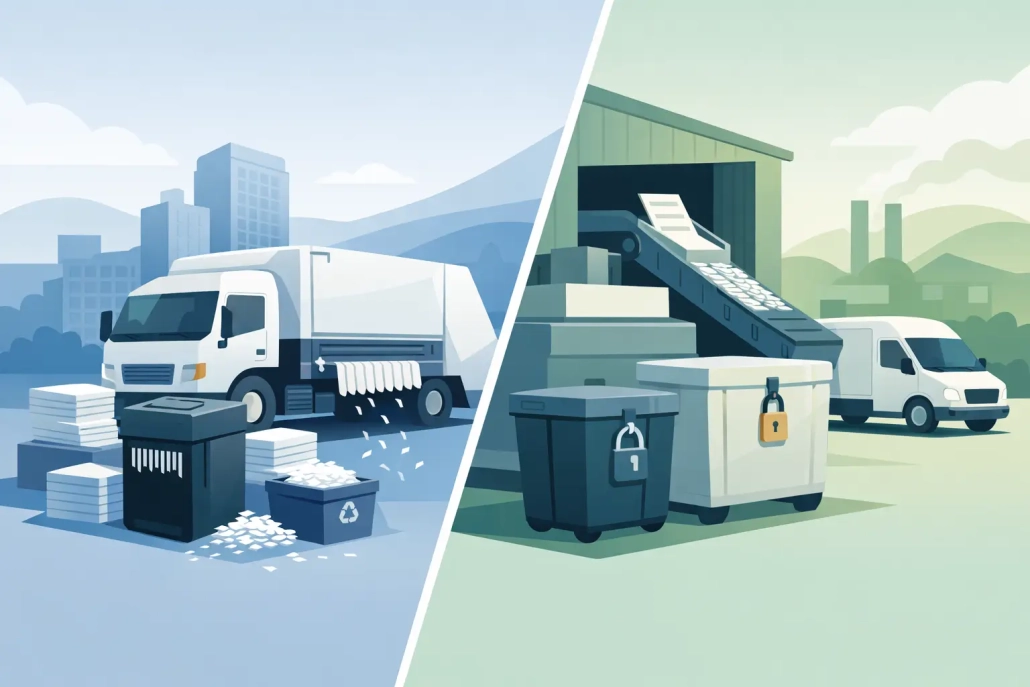
Onsite shredding means the material is destroyed at your location using a mobile shredding truck. Your documents are collected, moved under secure handling, and shredded before the truck leaves the site. For some businesses, that real-time destruction is the main reason to choose it.
Offsite shredding means confidential material is collected securely from your location, transported under chain-of-custody controls, and destroyed at a secure facility. This is often the better fit for scheduled service, larger archive clear-outs, and organizations that want secure destruction without paying for a truck to shred on location.
The mistake is assuming one is automatically safer than the other. That is not how professional document destruction works. Security depends less on the label and more on the provider’s processes – locked containers, trained staff, secure transport, controlled handling, verified destruction, and a Certificate of Destruction.
Security differences in onsite vs offsite shredding
If your business is highly sensitive to visibility, onsite shredding has an obvious advantage. The destruction happens at your premises, which means your team can witness the process if needed. For legal offices, medical practices, schools, and finance teams handling particularly sensitive records, that direct oversight can make internal stakeholders more comfortable.
That said, offsite shredding is still a secure option when the provider uses locked bins or security bags, documented pickup procedures, and controlled transport to a destruction facility. In many cases, the paperwork is already protected long before the truck arrives because it has been stored in lockable containers and handled as a confidential waste stream from the start.
The practical question is whether your business needs to see the shredding happen or simply needs assurance that it is handled correctly from pickup to destruction. Some compliance teams want the first. Many operations managers are satisfied with the second, especially when a free Certificate of Destruction is issued after service.
Cost and efficiency are often the deciding factors
This is where offsite shredding often stands out.
If you have pallet quantities of archive boxes, recurring confidential waste, or large clean-outs, offsite destruction is usually the more cost-effective choice. A secure facility is designed to process higher volumes efficiently, and that typically lowers the service cost per box, bin, or pickup.
Onsite shredding can cost more because the shredding equipment, truck time, and on-location processing all need to be factored into the service. For smaller loads or businesses that place a premium on immediate destruction, that extra cost may be justified. For bulk archive removal, it often is not.
This is where many businesses need a practical answer rather than a theoretical one. If your goal is to clear space, dispose of years of old records, and keep pricing under control, offsite shredding is often the smarter operational decision. If your goal is to witness destruction of a small but highly sensitive batch, onsite may be worth the premium.
Speed depends on the job, not just the method
Some buyers assume onsite is always faster because the shredding happens immediately. That is only partly true.
For a small load, onsite service can be very quick. The truck arrives, material is collected and destroyed, and the job is done. There is no second stage after pickup.
For larger projects, offsite shredding can actually be more efficient. Loading archive boxes or secure bins for transport is often faster than shredding a large volume at the curb. If your office has hundreds of boxes in storage, what matters most is how quickly the material can be removed from your premises and taken into a secure destruction process. In those cases, offsite service may reduce disruption and clear your site sooner.
Which option works better for scheduled service?
For ongoing office use, offsite shredding is usually the more practical fit. Businesses that generate confidential waste every week or every month generally want lockable bins placed on site, regular pickups, and minimal interruption to staff. That model is built around secure collection and facility-based destruction.
It is a straightforward system. Staff place paper in the locked bin. The provider collects it on schedule or on call. The material is removed securely and destroyed, and the business gets proof of service. That keeps confidential waste under control without asking employees to manage shredding in-house.
Onsite shredding is more common for one-time jobs, special requests, or businesses that specifically require witnessed destruction. It can still work on a recurring basis, but it is not always the most efficient setup for day-to-day commercial service.
Compliance and chain of custody matter more than the location
If you are reviewing onsite vs offsite shredding from a risk perspective, look beyond where the blades are.
Ask how the material is stored before pickup. Ask whether bins are lockable. Ask who handles the documents. Ask how transport is secured. Ask whether the provider issues a Certificate of Destruction. Ask whether paper is recycled after destruction. Those details tell you far more about service quality than the simple onsite or offsite label.
A secure provider should be able to explain the chain of custody clearly and without vague language. Your business should know when material is collected, how it is protected during handling, and what proof you receive once destruction is complete.
For regulated industries, that clarity matters. It supports internal policy, reduces the chance of ad hoc disposal mistakes, and gives managers documentation they can keep on file.
When onsite shredding makes the most sense
Onsite service is usually the right choice when your business wants immediate destruction at the point of collection, when stakeholders want to witness the process, or when the records are especially sensitive and visibility is part of your internal requirement.
It can also be a good fit for board records, legal files tied to specific matters, executive documents, or small batches of confidential media where control is the main concern. In those situations, the added convenience of on-premises destruction can outweigh the higher service cost.
When offsite shredding is the better choice
Offsite service is often the stronger option for routine pickups, large archive purges, multiple bins across a workplace, and organizations focused on balancing security with budget. It suits offices that want confidential waste removed regularly without interrupting operations.
It is also well suited to archive box destruction, pallet-scale file removals, and mixed service needs that may include paper, CDs, uniforms, or other sensitive materials. For many businesses, this is the practical middle ground – strong security, dependable handling, and better pricing for volume.
The best decision for most businesses
For most commercial customers, the answer is not that one method is universally better. It is that one method is better for the job in front of you.
If your priority is visibility, choose onsite. If your priority is cost control and volume efficiency, choose offsite. If you need recurring service, secure bins, on-call pickups, archive removal, and documented destruction, offsite collection with a professional chain of custody is often the most workable long-term solution.
That is why many businesses use both at different times. They may rely on scheduled offsite service for everyday confidential waste, then book onsite shredding for a specific high-sensitivity project. A good provider should be able to help you match the service to the risk level, volume, and budget rather than push a one-size-fits-all answer.
Metro Paper Destruction works with businesses that need exactly that kind of practical flexibility – secure collection, dependable service, free Certificates of Destruction, and competitive pricing for both recurring and one-off jobs.
If you are deciding between onsite and offsite shredding, start with the real question: what level of visibility, volume handling, and cost efficiency does your business actually need? Once that is clear, the right service choice is usually straightforward.


Leave a Reply
Want to join the discussion?Feel free to contribute!