
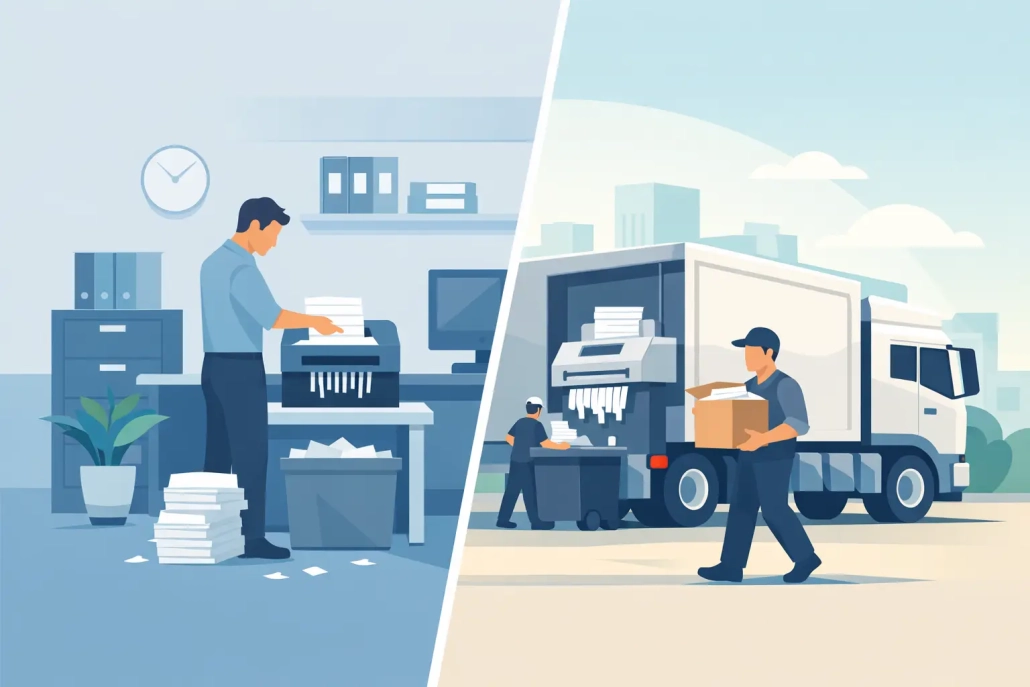
In House vs Outsourced Shredding
A full file room is easy to ignore until it becomes a risk. Old employee records, client files, financial paperwork, intake forms, and archived boxes all hold sensitive information long after their day-to-day use is over. That is where the real question starts: in house vs outsourced shredding. For most businesses, the right choice comes down to security, staff time, compliance, and whether document destruction is being treated as a side task or a controlled business process.
In house vs outsourced shredding: what is the real difference?
In-house shredding means your team handles destruction internally. That usually involves office shredders, staff feeding documents into machines, bagging shredded paper, and deciding when and how records get destroyed. On paper, it can seem cheaper because the equipment is already on site and the process feels under your control.
Outsourced shredding means a secure document destruction provider collects confidential material and destroys it under controlled procedures. That can include lockable bins for daily disposal, security bags, scheduled pickups, one-time cleanouts, archive box destruction, and proof of service through a Certificate of Destruction. Instead of asking office staff to manage disposal, the process is handled by a specialist with a chain of custody in place.
The gap between these two options is bigger than most businesses expect. It is not just about who owns the shredder. It is about who carries the operational burden and who reduces the risk.
Security is usually the deciding factor
If your business handles HR records, legal files, medical paperwork, financial documents, or customer data, shredding is not just a cleanup task. It is part of your information security process.
With in-house shredding, security often depends on staff consistency. Documents may sit in trays, on desks, beside printers, or in storage rooms waiting to be shredded. Boxes may be marked for destruction but remain untouched for weeks because the office is busy. Even when a shredder is available, there is a weak point between identifying records for disposal and actually destroying them.
That delay matters. Confidential material is most exposed when it is waiting for someone to get around to it.
Outsourced shredding closes that gap. Lockable consoles or bins allow staff to drop documents in immediately without leaving them in open areas. Scheduled pickup removes material on a regular cycle, and one-time purge services clear out archived records in bulk. A proper provider also gives you a documented chain of custody and a Certificate of Destruction, which is difficult to replicate with an office shredder and an informal internal process.
For businesses that need to prove secure disposal, outsourced service usually creates a stronger position.
The cost question is not as simple as buying a shredder
Many businesses lean toward in-house shredding because it appears cheaper upfront. A shredder is a visible purchase. Service costs are recurring, so they attract more scrutiny. But the actual cost of internal shredding is rarely limited to the machine itself.
You are also paying for staff time, machine maintenance, jams, breakdowns, replacement bags, dust management, disposal handling, and the lost productivity that comes from stopping administrative staff to destroy paper manually. If records are stored in archive boxes, in-house shredding becomes even less practical. Staff are not going to stand over a small office shredder feeding box after box of old files into the machine without that cost showing up somewhere else.
Outsourced shredding tends to shift the expense from hidden labor to a predictable service cost. That matters to operations managers and business owners who need straightforward budgeting. If you have regular confidential waste, scheduled service can be more cost-efficient than paying employees to handle it in small, inconsistent batches. If you have a backlog of files, a one-time purge is usually faster and cheaper than trying to clear it internally over months.
The businesses that benefit most are often not the largest. Mid-sized offices, clinics, law firms, schools, and multi-department workplaces usually find that internal shredding looks affordable only until someone measures the labor involved.
In-house shredding works in some cases
There are situations where in-house shredding can be reasonable. If your office produces very small volumes of confidential paper, has clearly trained staff, uses a cross-cut shredder rated for secure destruction, and destroys documents immediately, the risk can be manageable.
That tends to suit very small teams with limited paper records and no archive backlog. Even then, the process needs rules. Who is authorized to shred? Where is paper stored before destruction? How do you know documents were actually destroyed? How is shredded waste handled afterward?
Without those controls, in-house shredding becomes a loose routine rather than a secure system.
It is also worth being realistic about scale. A process that works for a five-person office often breaks down once headcount, paperwork, or compliance obligations increase.
Why outsourced shredding is often the better business decision
Outsourced shredding is built for consistency. Instead of relying on whoever has spare time in the office, you create a defined disposal process with secure collection, scheduled service, and documented destruction.
That has a practical effect on day-to-day operations. Staff do not need to sort out overflowing records rooms. Managers do not need to remind teams to shred boxes. Compliance staff do not need to wonder whether confidential waste was actually handled correctly. Records can move from desk to locked bin to secure destruction without unnecessary handling.
For archive cleanouts, outsourced service is especially useful. Old storage rooms and archived file areas often contain years of sensitive material. Trying to destroy that volume internally is slow, disruptive, and easy to postpone. A provider can remove archive boxes, bulk paper records, old files, and other confidential waste in a controlled pickup, which gets the risk out of your building quickly.
That convenience is not just about saving time. It reduces the chance that confidential material sits in hallways, loading areas, or unsecured storage while your staff figure out what to do with it.
Compliance, proof, and chain of custody
One of the biggest weaknesses of internal shredding is documentation. If you ever need to show that records were destroyed securely, what do you have? A staff member’s word is rarely enough.
Outsourced shredding services are stronger here because they are designed around controlled handling. Secure containers, trained collection procedures, tracked pickups, and Certificates of Destruction all support a clearer record of what happened and when. For regulated sectors and privacy-conscious organizations, that is a serious advantage.
This is particularly relevant for legal offices, medical practices, schools, finance teams, and any business that stores personal or confidential information. When destruction is outsourced properly, the disposal process is easier to defend because it is formalized.
How to decide between the two
The best choice depends on volume, risk, and internal capacity. If your business only shreds a handful of documents each week, in-house may be enough if procedures are strict and immediate. If documents tend to accumulate, if staff are already stretched, or if you need documented destruction, outsourced service is usually the safer and more efficient option.
Ask a few direct questions. Are confidential documents ever left waiting for shredding? Do staff spend paid time feeding paper into machines? Do you have archive boxes building up in storage? Can you prove destruction if asked? If any of those answers create hesitation, your current process is probably exposing the business to more risk than it should.
For many organizations, the right setup is not all or nothing. Small incidental shredding may stay internal, while regular confidential waste and archive purges are outsourced. That hybrid approach can work, but only if responsibilities are clear and nothing sensitive falls between the cracks.
A secure shredding process should make your business more protected, not more burdened. If internal shredding is consuming staff time, leaving records in storage, or creating uncertainty around compliance, it is time to treat destruction as a managed service instead of an office chore. For businesses that want security, convenience, and documented results, that shift usually pays for itself quickly.


Leave a Reply
Want to join the discussion?Feel free to contribute!