
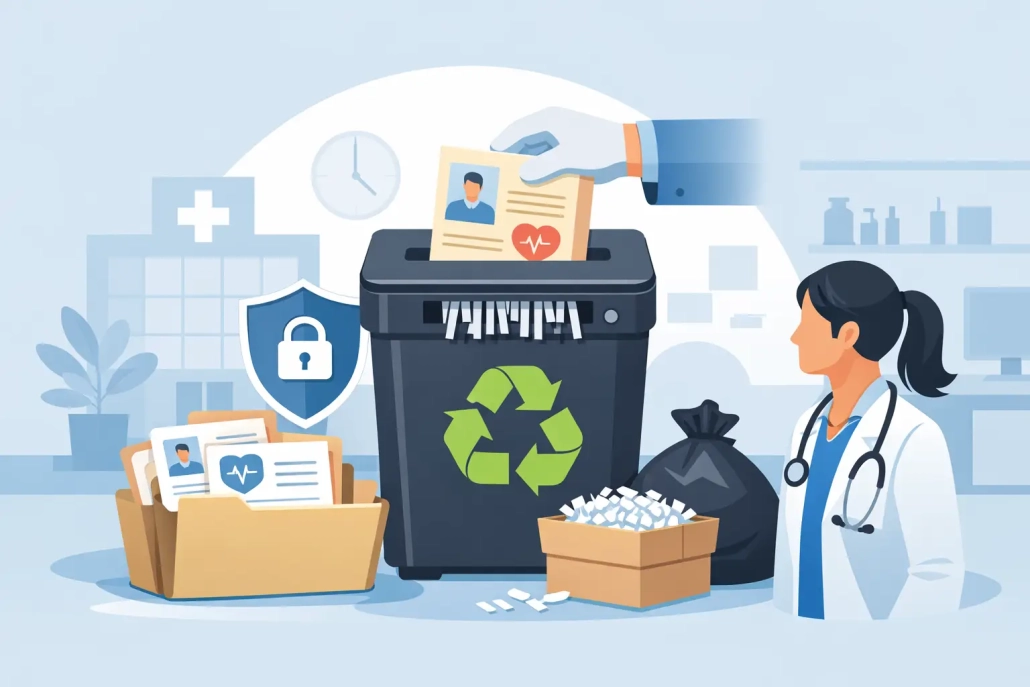
Medical Records Disposal Example for Clinics
A medical records disposal example is only useful if it reflects what actually happens inside a busy practice. Boxes pile up in storage, staff turnover happens, retention periods end, and someone has to make sure old patient files leave the premises securely. If that process is loose, undocumented, or handled in-house without controls, the risk sits with your business.
For medical practices, specialist clinics, dental offices, allied health providers, and larger healthcare groups, records disposal is not just a housekeeping task. It is a chain-of-custody job. Patient files contain names, addresses, treatment notes, billing details, and often identification information. Once those records are no longer required to be kept, they need to be destroyed in a way that is secure, documented, and practical for day-to-day operations.
A practical medical records disposal example
Say a multi-doctor clinic has 120 archive boxes of paper files in offsite storage and another 15 boxes in a back office. The practice manager has confirmed that a portion of those files has passed the required retention period under the clinic’s records policy. The clinic wants the job done quickly, without asking reception staff to sort, shred, or transport records themselves.
The disposal process starts with a clear scope. The clinic identifies which records are approved for destruction, separates them from active or hold files, and books a secure collection. Depending on volume, that may involve lockable bins for ongoing disposal, security bags for smaller batches, or a one-time archive box removal for a larger cleanout.
On collection day, the records are removed by an authorized destruction provider. Boxes are not left unattended for general waste pickup, and staff do not need to feed files through office shredders one stack at a time. The material moves through a controlled process, is destroyed securely, and a Certificate of Destruction is issued for the clinic’s compliance file.
That is the basic model. In practice, the details matter.
What should happen before destruction
Before any medical file is disposed of, the business should confirm two things. First, the retention period has actually expired. Second, the file is not subject to any legal hold, audit, complaint, insurance issue, or ongoing treatment need.
This is where many disposal problems start. A clinic may know it has “old files,” but not all old files are ready for destruction. Pediatric records, mental health records, diagnostic imaging, and specialist notes may have different retention requirements depending on the jurisdiction, patient age, and record type. The safest approach is to have an internal approval step before anything is collected.
In a well-run process, the practice manager, compliance lead, or records officer signs off on the disposal batch. That sign-off should match the business’s retention policy and identify the date range or file groups approved for destruction. Once that internal step is done, secure removal can proceed.
How secure collection should work
A proper medical records disposal example is not just about shredding. It is about protecting records from the moment they leave storage to the moment they are destroyed.
That usually means one of two service setups. For day-to-day disposal, clinics use lockable consoles or bins placed on-site so staff can deposit expired records without leaving them exposed in open recycling. For archive backlogs, the better option is a scheduled purge where sealed archive boxes are collected in bulk.
Both approaches reduce handling by clinic staff. That matters because every extra touchpoint creates another chance for error. If employees are carrying files through common areas, loading personal vehicles, or storing boxes in unsecured spaces while waiting for disposal, the process is already weaker than it should be.
A secure provider should be able to collect directly from your office, storage room, or archive area, then issue proof that destruction took place. For many organizations, that certificate is not optional. It is part of the audit trail.
Why office shredders are usually the wrong fit
Some smaller practices assume an office shredder is enough. For a handful of pages, maybe. For real archive disposal, usually not.
Medical files are thick, mixed with staples, clips, labels, and forms, and often stored in high volumes. Shredding them internally ties up staff time, creates bottlenecks, and still leaves questions about consistency. One employee may shred thoroughly, another may throw a full folder into the wrong waste stream, and no one has formal proof of destruction at the end.
There is also the issue of supervision. If records are shredded in-house over several days or weeks, you are relying on multiple staff members to apply the same standard every time. That can work in theory, but in most businesses, it is inefficient and hard to document.
For healthcare operators, outsourced secure destruction is usually the cleaner option because it removes the burden from front-office staff and provides a documented end point.
A simple disposal workflow that works
The most reliable medical records disposal example follows a repeatable workflow. The clinic reviews retention dates, approves destruction internally, separates the approved files, books a secure pickup, and receives a Certificate of Destruction once the job is complete.
If disposal is ongoing, the workflow can be built into normal operations. Expired records go into locked bins instead of general waste. Scheduled pickups keep volumes under control. Staff know where confidential paper goes, and the practice does not end up with years of files sitting in spare rooms.
If the job is a one-time purge, the same logic applies at a larger scale. The difference is volume, not principle. Archive boxes are identified, removed securely, and destroyed through a documented process.
What businesses often overlook
The biggest gap is usually not shredding capacity. It is chain of custody.
Businesses often focus on the final act of destruction and overlook what happens before that. Where were the records stored? Who approved disposal? Were boxes labeled clearly? Did anyone outside authorized staff have access? Was there proof that the exact material collected was destroyed?
Another common issue is mixed media. A medical office may be clearing paper files but also have backup CDs, printed billing reports, ID copies, and old staff documents in the same storage area. If those materials are confidential, they should be included in the disposal plan rather than left behind for someone to deal with later.
That is where a broader confidential destruction service can help. Paper, archive boxes, digital media, and even branded uniforms can all create unnecessary exposure if disposal is delayed or handled casually.
Choosing the right service model
Not every healthcare business needs the same setup. A two-doctor office with limited storage might only need occasional pickups or security bags for periodic cleanouts. A larger clinic group or hospital department may need scheduled bin servicing plus annual archive destruction.
It depends on record volume, available storage, internal staffing, and how often retention reviews occur. The goal is not to buy more service than you need. The goal is to make sure no confidential records sit around because disposal is inconvenient.
That is why flexible collection matters. Some businesses need a one-time archive purge after years of accumulation. Others need an ongoing program that quietly handles confidential waste every month. Both are valid. The better fit is the one your team will actually use consistently.
What a documented result should look like
After destruction, the business should have a clear record of what was done. That generally includes the service date, the type or volume of material collected, and a Certificate of Destruction for internal records.
For compliance-minded organizations, this paperwork is part of risk control. If a question comes up later about how expired patient files were handled, you want more than verbal reassurance. You want a documented outcome tied to a secure service process.
That also helps with internal accountability. Practice managers, office administrators, and compliance staff can show that records were not simply removed – they were destroyed properly.
The real value of a professional disposal process
A good disposal process saves time, but that is not the main reason to use one. The real value is risk reduction.
Old medical records are easy to ignore because they are no longer active. But inactive does not mean harmless. Archived files still carry personal information, and if they are lost, mishandled, or thrown out improperly, the damage is immediate. Secure destruction closes that exposure in a controlled way.
For businesses that want the process handled properly without tying up staff, Metro Paper Destruction provides secure collection, archive box removal, scheduled services, and free Certificates of Destruction. Whether you need ongoing disposal or a one-time records cleanout, the right setup is the one that keeps confidential material moving out securely instead of sitting in storage.
If you are looking at a room full of old files and wondering where to start, start with control. Identify what can go, arrange secure pickup, and make sure the job ends with documented destruction you can stand behind.


Leave a Reply
Want to join the discussion?Feel free to contribute!