
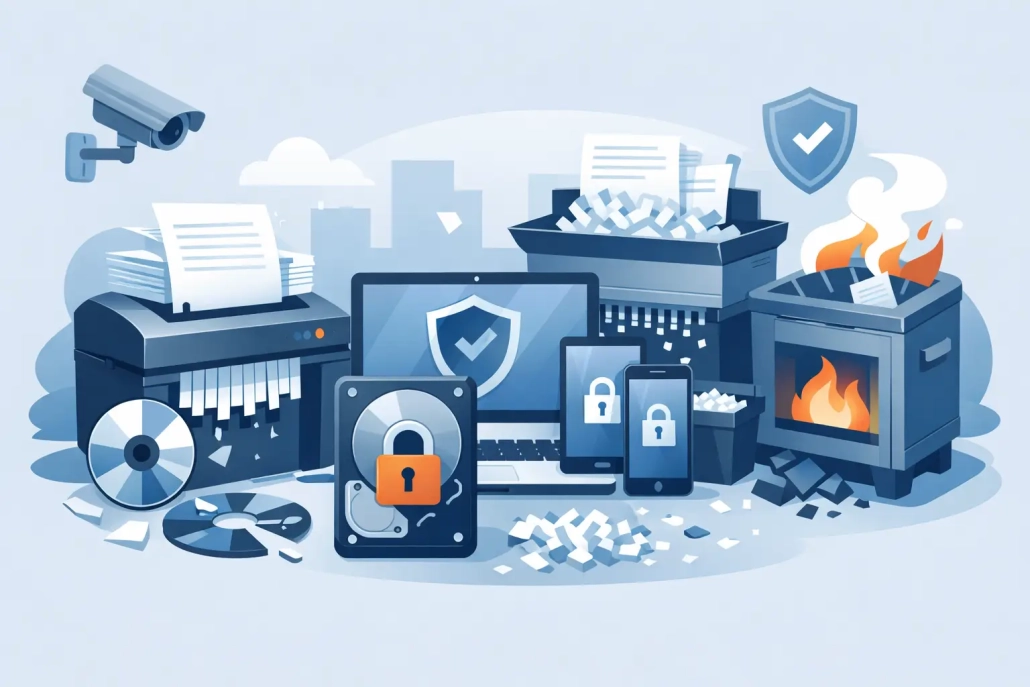
Secure Media Destruction Methods for Business
A locked filing cabinet is not a disposal plan. Once records, CDs, staff uniforms, or archived boxes are no longer needed, they can become an avoidable security risk. Secure media destruction methods give businesses a controlled way to remove confidential material, destroy it properly, and document what happened from collection through final processing.
For office managers, compliance teams, and business owners, the right method depends on the material, the volume, and the sensitivity of the information involved. A few papers from a desk drawer require a different approach than years of archived client files or a pallet of redundant records. The common requirement is the same: confidential material must not be left in general waste, recycling bins, or unsecured storage while waiting for disposal.
Why secure disposal needs more than a recycling bin
Paper and digital media often contain more information than expected. Printed reports may include customer names, account details, employee records, medical information, signatures, pricing, or internal correspondence. CDs and DVDs can hold backups, client files, presentations, databases, and system exports. Even old uniforms can create a security concern when they display employee names, company branding, access labels, or government and service-provider identification.
Putting these items in ordinary recycling may seem convenient, but it removes control over who handles them and where they end up. Internal office shredders can help with small quantities, yet they are rarely practical for archive cleanouts, and they do not provide a clear external chain of custody or a formal destruction record.
A professional process is designed to reduce those gaps. Materials are collected in secure containers or removed directly by trained staff, transported for destruction, processed through the appropriate method, and supported by a Certificate of Destruction. That certificate provides a useful audit trail for internal records, privacy procedures, and supplier management.
Secure media destruction methods by material type
There is no single destruction method that suits every item. The goal is to make the information or identifying material irretrievable while handling the job efficiently and responsibly.
Paper shredding for daily confidential waste
For regular office documents, secure shredding is the standard method. Businesses can use lockable collection bins placed in offices, print areas, records rooms, or administration spaces. Staff place confidential papers in the bin instead of tossing them into desk-side waste containers, reducing the risk of documents being misplaced before disposal.
A scheduled collection service suits businesses that generate confidential waste every week, fortnight, or month. The bins are exchanged or emptied as required, keeping secure disposal routine rather than leaving it to staff when the office becomes cluttered.
This approach works well for invoices, payroll paperwork, client forms, HR files, legal correspondence, financial records, reports, and printed operational documents. It is also a practical way to improve office organization. Documents that no longer need to be retained can leave the premises securely instead of accumulating in cabinets and storage rooms.
Archive box destruction for stored records
Archive boxes present a different challenge. They often contain mixed files from multiple years, and businesses may have hundreds or thousands of boxes taking up valuable storage space. Sorting every page before destruction can be time-consuming, expensive, and unnecessary once the retention period has passed.
Secure archive box destruction allows whole boxes to be removed for confidential processing. This is particularly useful for law firms, medical offices, accounting practices, schools, property managers, and organizations with long-term records obligations. The boxes can be collected from a records room, basement, warehouse, or off-site storage area as part of a one-time cleanout or a larger archive removal project.
Before booking a destruction service, confirm that the required retention period has ended and that no legal hold, audit requirement, or active matter affects the files. Destruction should be final. Good records management means knowing what may be destroyed, approving it internally, and then removing it securely without delay.
CD and optical media destruction
Old CDs, DVDs, and similar optical media should not be treated as harmless office clutter. A disc may contain data that is not visible from its label, including archived backups, customer records, staff information, photographs, software, or sensitive internal material.
Secure CD destruction physically breaks down the media so it cannot be read or reconstructed. This is a better option than throwing discs into general waste or relying on staff to snap them by hand. Hand-breaking is inconsistent, creates sharp waste, and does not provide proof that every item was destroyed.
Businesses should also remember that a disc case, printed label, or handwritten note can expose information. Keep media and its associated paperwork together in the secure disposal process rather than separating them into different waste streams.
Uniform destruction for branded and issued clothing
Uniforms are often overlooked in a security policy. Retired apparel may carry a company logo, employee name, security designation, school identity, or service-provider branding. If it is donated, discarded, or sold without controls, it may be worn by someone with no connection to the organization.
Secure uniform destruction prevents branded garments from re-entering circulation. This is especially relevant for security providers, medical services, utilities, transport businesses, schools, government-related organizations, and companies with staff-issued clothing. It also helps protect brand standards when old uniforms are damaged, outdated, or no longer authorized for use.
Collection security matters as much as destruction
The destruction equipment is only one part of the process. A business can still face exposure if confidential materials sit unsecured before pickup or are handled informally during removal.
Look for a provider that can offer lockable bins for ongoing paper waste and secure bags for smaller quantities or flexible collections. For archive projects, the collection team should be able to remove boxes directly from the nominated area and manage larger volumes, including pallet-scale removals where needed.
The practical advantage is clear: staff do not need to load confidential boxes into personal vehicles, make repeated trips to a recycling center, or store material in a hallway until someone has time to deal with it. A managed collection keeps the process controlled from the moment records leave your custody.
For recurring needs, scheduled pickup is usually the most efficient option. For office relocations, retention cleanouts, renovations, or a sudden release of storage space, an on-call pickup or one-off destruction service may be the better fit. The right arrangement should match your volume rather than force your business into a service level it does not need.
What proof should your business receive?
A Certificate of Destruction should be part of the service, not an extra afterthought. It records that the confidential material was collected and destroyed through an accountable process. Keep certificates with your disposal, compliance, or records-management documentation.
The certificate does not replace a retention policy, but it supports one. If your organization is asked how it handled outdated customer files, employee records, or confidential media, you should be able to show that the material was disposed of through a professional destruction process.
It is also worth confirming how materials are handled after destruction. Paper can often be sent for recycling after confidential shredding, helping businesses meet security and environmental responsibilities at the same time. Responsible disposal does not require choosing between privacy protection and waste reduction.
Choosing the right service for your volume
Small offices may only need a lockable bin and regular collection. A business clearing old files before a move may need dozens of archive boxes removed in one visit. Larger organizations may need pallet-scale removal from a storage facility, alongside ongoing bins for daily confidential waste.
Price matters, but it should be considered alongside collection security, flexibility, documentation, and the provider’s ability to handle the entire job. A low-cost option is not a saving if your staff must spend days sorting records, transporting boxes, or managing unsecured waste in the meantime.
Start by identifying what you have, where it is stored, and whether it is paper, optical media, uniforms, or a mix of materials. Then arrange a service that removes it securely and provides clear proof of destruction. Confidential material becomes less of a risk when disposal is treated as an operational process, not a last-minute cleanup.


Leave a Reply
Want to join the discussion?Feel free to contribute!