
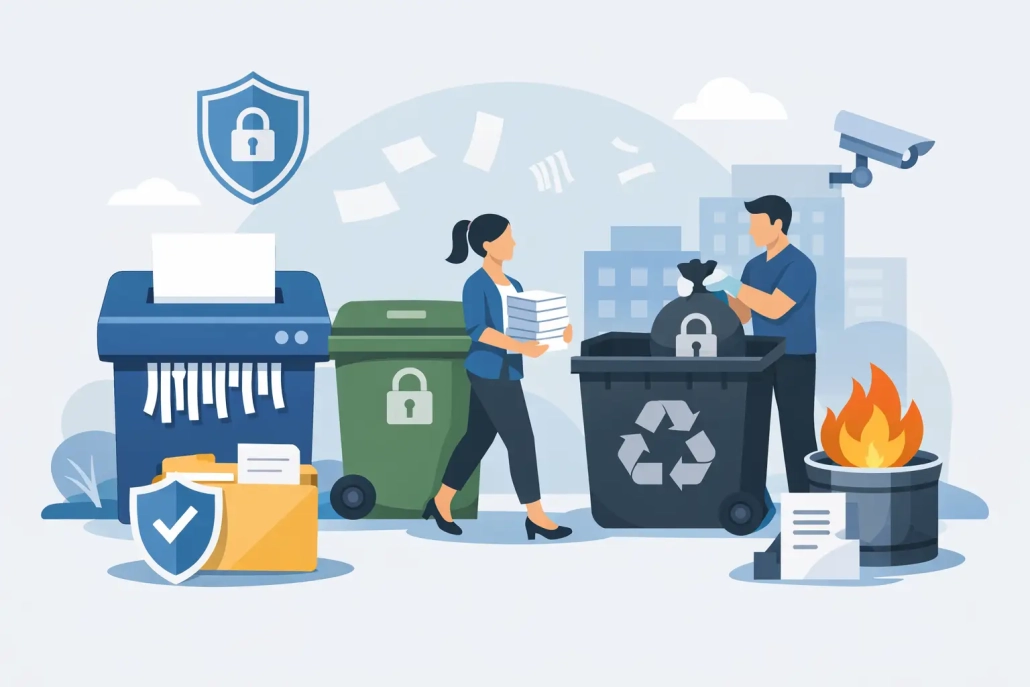
How to Manage Secure Waste at Your Business
A file left beside the copier, an old staff uniform in a storeroom, or a box of archived client records can all create the same problem: sensitive information is still accessible. Knowing how to manage secure waste means controlling confidential materials from the moment they are discarded until their destruction is documented.
For businesses handling customer details, employee records, financial information, medical files, legal documents, or internal data, regular trash and open recycling bins are not acceptable disposal methods. A secure waste process reduces the risk of privacy breaches, lost records, and unauthorized access while keeping your workplace organized.
Start by Defining What Counts as Secure Waste
Secure waste is any material that contains information, branding, or media that should not be accessed after disposal. Paper is the most common example, but it is not the only one. A practical policy should cover documents created in the office, records held in storage, and materials generated during clean-outs or staff changes.
Common secure waste categories include:
- Paper records such as invoices, client files, payroll reports, contracts, applications, and internal correspondence
- Archive boxes containing outdated business, legal, financial, medical, or personnel records
- Digital media, including CDs, DVDs, backup discs, and other media containing business data
- Branded uniforms, ID materials, and apparel that could be misused or expose your organization’s identity
The right level of control depends on what the material contains. A draft memo may need routine secure collection, while files containing health information, account details, or legal records may require tighter access controls and faster removal. The key is to avoid leaving that decision to individual employees at the point of disposal.
Create One Clear Disposal Process
The most effective secure waste program is simple enough that staff follow it every day. If employees need to find a key, ask for permission, or carry sensitive paperwork across the building, documents are more likely to end up in desk drawers or general recycling.
Place lockable secure bins where confidential paper is regularly generated. For many offices, that means near printers, administration areas, HR, finance, reception, and records rooms. Lockable 240-liter bins are suitable for ongoing office volumes because they keep deposited documents out of reach while allowing staff to use the service without interruption.
For smaller volumes or teams that work across multiple locations, security bags can be a practical option. They give staff a controlled place to store confidential waste until collection without taking up the space of a large bin.
Your written procedure should state what goes into secure containers, who can access them, and what staff should never do. That includes placing confidential paper in standard recycling, taking records home for disposal, or leaving full archive boxes in hallways and loading areas.
Keep General Waste Separate
Secure waste and general recycling serve different purposes. Paper that does not contain confidential information may be suitable for normal recycling, depending on your workplace policy. Sensitive records should be treated differently because the risk exists before recycling takes place.
This separation also helps control costs. When secure bins are reserved for confidential material, your provider can collect and destroy the records that need protection without charging you to process unnecessary waste.
Choose the Right Collection Schedule
A collection schedule should match the amount of confidential waste your business generates, not an arbitrary calendar date. A busy medical office, legal practice, school, or finance department may need scheduled service every week or every month. A small business may only need an on-call pickup when its security bags or bins are full.
Scheduled pickups are usually the best choice when document waste is steady. They prevent bins from overflowing, give staff a consistent process, and remove the need for office managers to remember to arrange collection each time.
On-call pickups work well when volumes fluctuate. They are useful for project work, seasonal record processing, office relocations, or departments that only create confidential waste occasionally. A one-off clean-out is often the better option when a storeroom, archive area, or vacated office contains years of accumulated files.
There is a trade-off. Frequent pickups can improve convenience and reduce the amount of material stored on-site, while less frequent service may be more cost-effective for low-volume businesses. Review bin fill levels after the first few collections, then adjust the schedule before secure waste becomes a storage problem.
Maintain Chain-of-Custody Security
Secure waste management is not just about shredding. It is about ensuring materials remain protected throughout collection, transport, and destruction. That process is often called chain of custody.
At your site, chain of custody begins with lockable containers and controlled access. Once the material is collected, it should be removed by trained personnel and handled as confidential material, not mixed with ordinary waste. Clear collection procedures reduce the chance of boxes being misplaced, bags being opened, or records sitting unsecured at a loading dock.
For large archive removals, plan the collection before the crew arrives. Identify the boxes or pallets to be removed, make sure pathways are clear, and nominate a staff contact who can confirm what is leaving the premises. If different record groups have different retention requirements, separate them before collection so that only approved materials are destroyed.
Do not overlook digital media and uniforms. A CD may hold old backups or customer records, while a discarded uniform can expose your brand or be used to gain credibility with customers. Both need a secure destruction process rather than a general trash bin.
Ask for Proof of Destruction
A secure waste provider should supply a Certificate of Destruction after the service. This record confirms that your confidential materials were collected and destroyed through a documented process.
Certificates are useful for more than filing. They support internal compliance records, give management evidence that disposal procedures were followed, and help answer questions during audits or investigations. Keep certificates with your other records management documentation, and make sure the relevant office manager, compliance contact, or records manager knows where they are stored.
If you use a provider for scheduled pickups, confirm whether certificates are issued for each collection or under an agreed service arrangement. For one-off archive destruction, check that the certificate clearly relates to the job completed. Free Certificates of Destruction should be a standard part of a professional service, not an unexpected extra charge.
Train Staff Without Making It Complicated
Even the best bins and collection schedule will fail if staff do not understand the rules. Training does not need to be lengthy. Include secure waste procedures in new employee onboarding, refresh the rules when policies change, and give managers a clear point of contact for questions.
Staff should know where secure bins are located, which materials belong inside them, and why normal recycling is not suitable for sensitive records. They should also understand that confidential waste includes handwritten notes, printed emails, labels, reports, and duplicate copies, not only formal client files.
A short reminder near printers or in staff communications can prevent common mistakes. The message should be direct: if a document contains personal, financial, operational, or customer information, place it in the secure bin.
Review Your Process During Changes
Secure waste volumes often increase when a business moves offices, replaces systems, changes storage providers, closes a department, or completes a records retention review. These are the times when ordinary office procedures can break down.
Before a move or clean-out, identify confidential material early. Avoid the last-minute approach of throwing mixed boxes into a truck or arranging disposal after files have been left in an unsecured space. Pallet-scale archive removal can be more efficient for large volumes, while individual archive box destruction suits smaller projects.
It is also worth reviewing your process after a service issue, staffing change, or period of rapid growth. A bin that was sufficient for ten employees may not be sufficient for fifty. A collection interval that worked for paper records may need adjustment after a new system generates more printed reports.
Make Secure Disposal a Routine Business Control
The aim is not to create more administration. It is to remove uncertainty. With lockable bins or security bags, reliable pickups, secure removal, documented destruction, and responsible recycling, confidential waste becomes a controlled business process instead of a recurring risk.
Choose a provider that can handle ongoing collections, on-call pickups, one-off archive clean-outs, CDs, and uniforms as your needs change. Competitive pricing matters, but it should sit alongside clear security procedures and proof that the job was completed. When secure disposal is easy for staff and visible to management, protecting confidential information becomes part of how your business operates every day.


Leave a Reply
Want to join the discussion?Feel free to contribute!