
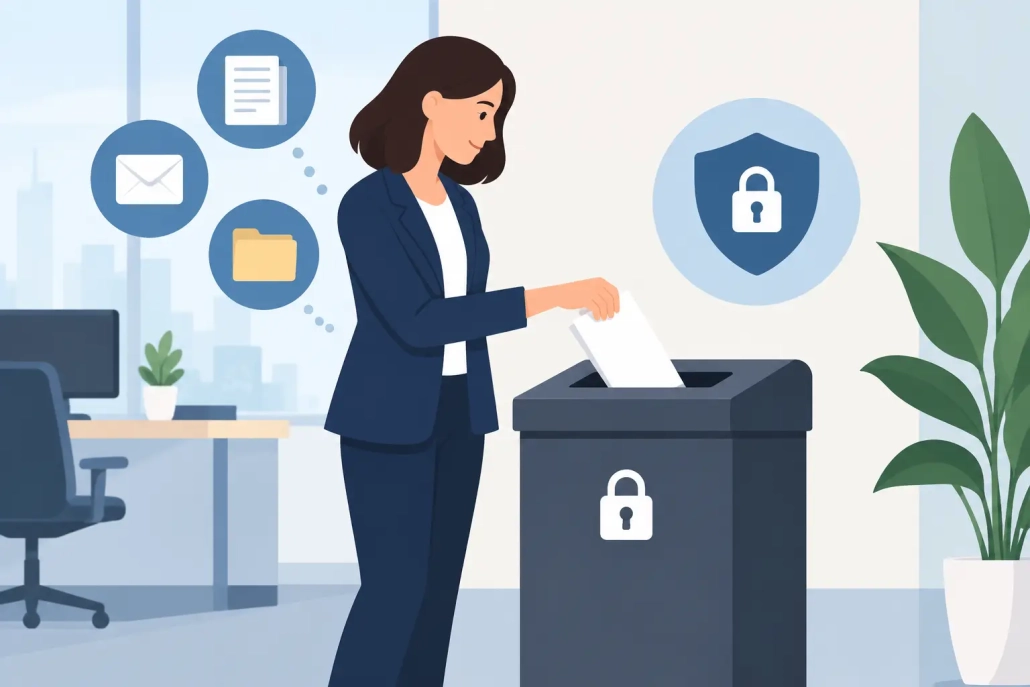
What Goes in Confidential Bins at Your Workplace?
A confidential bin should not be treated like a regular recycling container. The question of what goes in confidential bins comes down to one simple test: could the item reveal private, financial, operational, employee, customer, or client information if it ended up in the wrong hands? If the answer is yes, it belongs in secure destruction.
For businesses, secure bins remove the uncertainty of office disposal. Instead of staff tearing up paperwork, carrying files to public recycling, or leaving archive boxes in storage areas, confidential material is placed into a locked bin and collected for secure destruction. It is a practical way to protect information while keeping offices clear and organized.
What Goes in Confidential Bins?
Most day-to-day business paperwork containing sensitive information can go directly into a confidential bin. This includes printed documents, working papers, records, and files that are no longer required for business, legal, or operational purposes.
Common examples include:
- Client files, customer records, contact lists, and account information
- Employee records, payroll documents, resumes, timesheets, and performance reviews
- Financial paperwork, including invoices, bank details, tax documents, budgets, and credit applications
- Medical, legal, education, insurance, or government-related records
- Internal reports, meeting notes, business plans, pricing schedules, and tender documents
- Printed emails, draft contracts, quotations, purchase orders, and delivery paperwork
- Marketing lists, registration forms, surveys, applications, and handwritten notes
Paper does not need to be marked “confidential” to require secure disposal. A page with a name, address, email address, phone number, employee number, account reference, signature, or internal business detail can create a privacy risk. Even seemingly routine documents can be useful to someone attempting fraud, identity theft, or unauthorized access.
Documents can usually be placed in the bin with staples, paper clips, binder clips, and small folders still attached. Removing these items creates unnecessary work for staff and can lead to sensitive papers being left on desks or in regular waste. For large lever-arch folders, bulky files, or archive boxes, a dedicated archive destruction service is generally the more efficient option.
Records That Are Easy to Overlook
Not every confidential item looks like a formal file. Reception areas, HR departments, accounts teams, schools, medical practices, and professional offices often generate sensitive paper in smaller formats throughout the day.
Think about visitor sign-in sheets, appointment lists, delivery dockets, handwritten message pads, photocopies of identification, old staff rosters, training records, and returned mail. These items may be easy to discard casually, but they can still expose personal or business information. A locked confidential bin gives staff one clear, secure disposal point.
What Should Stay Out of Confidential Bins?
Confidential bins are intended primarily for paper-based confidential waste. Keeping unsuitable materials out protects collection staff, prevents contamination, and helps ensure the material can be processed correctly for recycling after destruction.
Do not place food, drink containers, liquids, general garbage, batteries, toner cartridges, chemicals, or sharps in a confidential paper bin. Wet or contaminated paper can disrupt secure processing and may make recycling impossible. Cardboard packaging is also best handled through your regular recycling stream unless it contains sensitive printed information.
Digital media should be separated from paper. CDs, DVDs, USB drives, hard drives, backup tapes, and other storage devices can hold substantial amounts of confidential data and require a different destruction process. They should be collected for secure media destruction, not dropped into a paper bin.
The same applies to branded uniforms, ID badges, old access cards, and other items that could identify your organization or allow unauthorized access. These materials may need secure destruction, but they should be booked as a separate service so they are handled properly.
How to Decide if a Document Belongs in Secure Disposal
When staff are unsure, the safest approach is to place the item in the confidential bin. A document does not need to contain a full customer profile or financial statement to create risk. One page of notes can reveal enough about a client, employee, project, or internal process to be damaging if it is recovered from ordinary trash.
Ask three practical questions before placing paper in general recycling: Does it identify a person or business? Does it reveal financial, health, employment, legal, or commercial information? Could it cause harm, embarrassment, loss, or a compliance issue if another party saw it? If any answer is yes, use secure destruction.
This approach is particularly useful for shared offices, where several teams use the same printers and waste areas. It eliminates guesswork and gives every employee a clear standard for handling unwanted records.
Make Confidential Bin Use Easy for Staff
A secure disposal process only works when it is convenient. If a confidential bin is tucked away in a storeroom or only available to one department, staff may default to desk-side recycling bins or regular garbage. Place lockable bins where confidential paper is generated most often, such as near printers, finance teams, HR areas, reception, records rooms, and administration workstations.
Clear instructions also help. Staff do not need a long policy to use the bin correctly. A simple reminder that all unwanted documents containing personal, client, employee, financial, or internal business information belong in the secure bin is usually enough.
For businesses with high volumes of paper, scheduled collections prevent bins from becoming overfilled. Smaller offices may prefer an on-call pickup when a bin is full, while organizations clearing old storage rooms or records areas may need a one-time archive clean-out. The right arrangement depends on how much confidential material your business produces and how long it needs to be retained before destruction.
Secure Bins Protect More Than Paper
A lockable confidential bin supports a stronger chain of custody from the moment a document is discarded. Rather than sitting in an open recycling container, sensitive material remains secured until collection. It is then removed for destruction and recycling through a controlled process.
For organizations that must demonstrate responsible information handling, proof matters as much as the collection itself. A Certificate of Destruction provides a record that confidential materials were securely destroyed. This can support internal policies, audit requirements, privacy obligations, and records management procedures.
There is also an operational benefit. Staff spend less time feeding paper through small office shredders, emptying shredder bags, fixing paper jams, or deciding which documents are safe to recycle. A managed bin service makes secure disposal part of normal office workflow instead of an occasional clean-up task.
When You Need More Than a Confidential Bin
Bins are ideal for regular, everyday confidential paper. They are not always the best answer for years of archived records, large quantities of boxed files, or a relocation, office closure, or storage-room clean-out. In those situations, secure archive box collection or pallet-scale removal is usually faster and more cost-effective than trying to feed old files into an office bin over several weeks.
Metro Paper Destruction provides lockable 240-liter confidential bins, scheduled and on-call collections, and one-off destruction services for Melbourne businesses. Secure removal, document destruction, recycling, and a free Certificate of Destruction keep the process straightforward from collection through to completion.
The best rule is simple: if a document could expose someone, reveal business information, or create a problem when discarded, do not leave it to chance. Put it in the confidential bin and make secure disposal the easy choice for every member of your team.


Leave a Reply
Want to join the discussion?Feel free to contribute!