
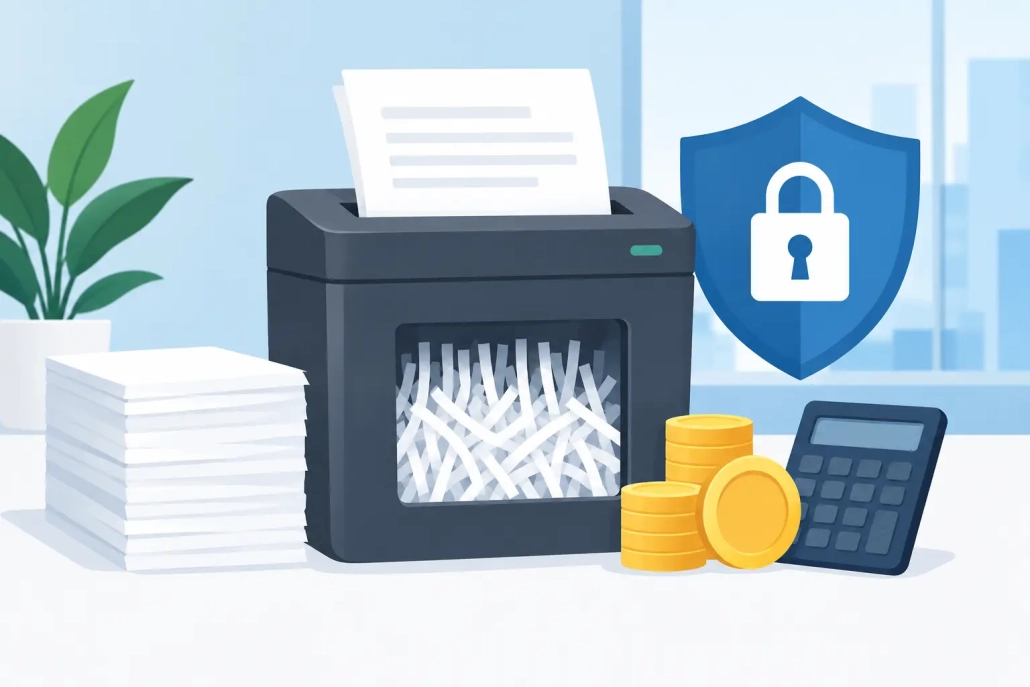
What Do Secure Shredding Costs Include for Business?
A cheap shredding quote can become expensive if it leaves your confidential records sitting unsecured in an office, adds unexpected collection fees, or provides no proof that destruction occurred. For Melbourne businesses, shredding costs should be assessed against the full service: secure containment, collection, transport, destruction, recycling, and a clear chain of custody.
The right service is not simply the lowest price per box or bin. It is the one that removes risk without making document disposal another job for your team. Whether you need regular collections from a busy office or a one-time archive clean-out, the cost should be clear before the work begins.
What affects shredding costs?
Most professional document destruction providers price work according to the volume of material, the collection format, and how often service is required. A small office with a locked bin collected on a schedule has different needs from a law firm clearing years of archived client files.
The main cost factors are straightforward: how much material you have, whether it is loose paper or boxed archives, the pickup location, access requirements, and whether the job is ongoing or one-time. Specialty materials, such as CDs, uniforms, branded products, or mixed media, may also require separate handling.
A transparent quote should explain what is included. Ask whether the price covers collection, secure transport, destruction, recycling, and a Certificate of Destruction. These are core parts of a secure service, not optional extras that should appear later on an invoice.
Volume and material type
Paper volume is usually the starting point. Regular confidential waste is often managed through lockable bins or security bags, while older files may be priced by archive box, pallet, or overall load. Large archive projects can be more cost-effective per box than a very small one-off pickup because collection and handling can be planned efficiently.
Material type matters because not every item can be processed in the same way. Paper records may include staples, paper clips, folders, or binder clips, depending on the provider’s process. CDs, hard media, uniforms, identification cards, and branded items need destruction methods that make the contents or branding unusable. Be specific about what you need destroyed when requesting a quote.
Scheduled service versus one-time pickups
Scheduled collections are usually the practical choice for businesses that generate confidential waste every week or month. A lockable 240-liter bin placed in a suitable area gives staff a secure disposal point and prevents sensitive papers from building up in desks, printer rooms, or general waste areas.
With a scheduled service, pickup frequency should match your actual waste volume. Over-servicing an almost empty bin is unnecessary spend. Under-servicing creates overflow and can encourage staff to use unsecured disposal methods. A provider should help you choose a collection cycle that fits the way your office operates.
One-time pickups are better suited to office moves, records room clear-outs, end-of-year file disposal, or the removal of long-held archives. These jobs may require box counts, pallet handling, loading assistance, or access planning for basements, storage rooms, lifts, and loading docks. The quote should reflect the work required, rather than relying on a vague flat fee.
The real cost of insecure disposal
Comparing shredding costs only by the cheapest collection price can miss the larger cost of a security failure. Client records, employee files, financial documents, medical information, legal correspondence, and internal business plans should never enter ordinary recycling or general waste streams.
An in-house shredder may look inexpensive, but the real expense includes staff time, machine maintenance, jams, noise, electricity, bagging, and the ongoing risk of documents being left beside the machine. Strip-cut shredders also do not provide the same controlled collection and destruction process as a professional service.
There is also a practical issue: employees rarely have time to stand over a shredder while managing normal work. When destruction becomes inconvenient, documents often accumulate. A locked bin provides a simple process – staff deposit confidential paper as they work, and authorized personnel collect it for secure destruction.
For organizations with privacy obligations or internal compliance requirements, proof matters. A free Certificate of Destruction provides a record that materials were securely destroyed. It is useful for audits, internal reporting, governance requirements, and the simple reassurance that a completed clean-out did not end at a loading dock or recycling container.
What a complete shredding quote should cover
Before accepting a quote, make sure you are comparing like for like. One provider may quote only for paper removal, while another includes secure containers, collection, transport, destruction, recycling, and certification. The lower figure is not automatically the better value if key security steps are excluded.
A clear quote should answer practical questions. Does it include a lockable bin or security bags? Is collection on-call, scheduled, or both? Are archive boxes collected from inside the premises? Is there an additional charge for stairs, restricted access, parking, or pallet loads? Will you receive a Certificate of Destruction after the job?
For recurring service, ask whether there is a minimum term, a minimum pickup volume, or a fee for missed or aborted collections. These conditions are not necessarily a problem, but they should be known upfront. Your service arrangement should be easy to manage, especially if your office headcount or document volume changes.
Do not pay for capacity you do not need
A large bin and frequent collections may appear convenient, but they are only cost-effective when they match your output. Conversely, choosing the smallest possible container can create collection pressure and poor disposal habits. The sensible approach is to estimate your monthly confidential paper volume, then review the service after the first few collections.
For archive destruction, prepare an accurate box count where possible. Note whether boxes are standard archive cartons, whether they are already accessible, and whether there are unusually heavy items such as lever-arch files. Good information leads to an accurate quote and avoids delays on collection day.
How to reduce document destruction costs without reducing security
The best way to control spending is to make confidential disposal part of your normal office process. Place secure bins where documents are generated, such as near printers, administration areas, finance teams, or records rooms. This reduces the need for staff to sort through mixed waste later and keeps paper out of unsecured areas.
Set a clear internal rule about what belongs in secure destruction. Employee records, customer information, invoices, quotes, reports, meeting notes, printed emails, and draft documents can all contain information that should not be discarded casually. When staff know where material goes, your organization avoids costly clean-ups and inconsistent handling.
For larger archive projects, avoid rushing the booking. A planned collection gives you time to count boxes, identify access needs, separate materials that require different destruction methods, and choose a collection time that will not disrupt staff or customers. It may also allow for more efficient removal of pallet-scale records.
Finally, choose a provider that can handle changing needs. A business may need regular bin collection for most of the year, then require an extra pickup after a filing project or a major archive removal before an office move. Flexible service options prevent you from paying for a rigid arrangement that no longer suits the business.
Security, convenience, and price should work together
Affordable document destruction should not mean compromising on secure handling. The strongest value comes from a service that makes correct disposal easy for staff, removes material reliably, destroys it through a controlled process, and supplies documented proof afterward.
Metro Paper Destruction provides Melbourne businesses with lockable bins, security bags, scheduled pickups, on-call collections, and one-time archive removal, with Certificates of Destruction supplied at no charge. The right quote depends on your volume and service requirements, but it should always be simple to understand.
If confidential paper is taking up space in your office, archive room, or storage facility, get a clear quote based on the work you actually need. Secure disposal is easier to budget for when every step is included from collection through to certified destruction.


Leave a Reply
Want to join the discussion?Feel free to contribute!