
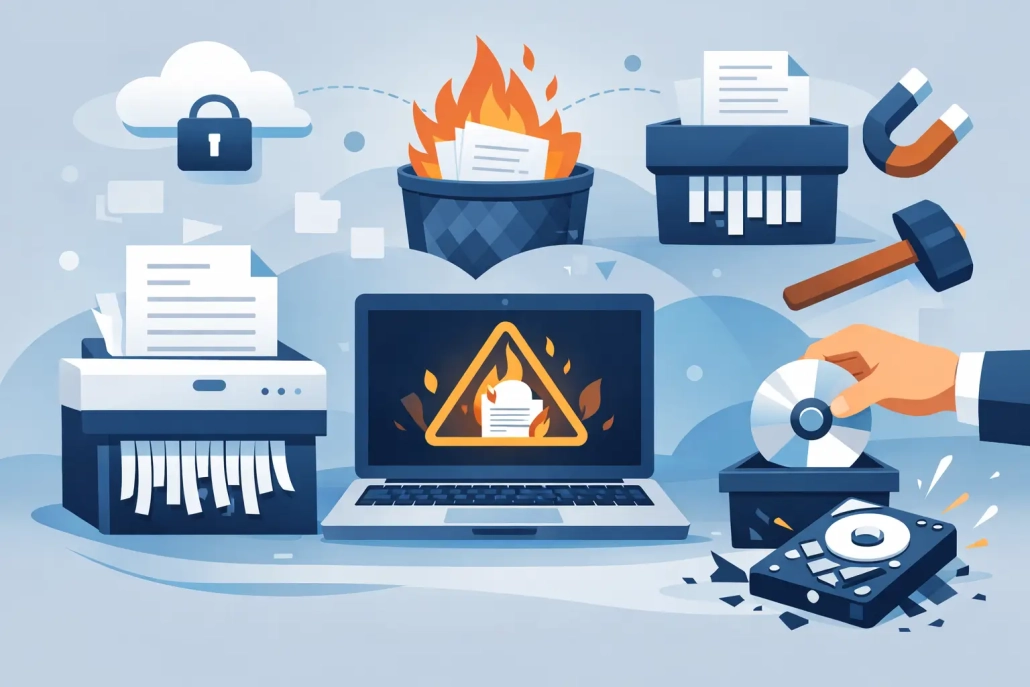
7 Best Ways to Destroy Files at Work Securely
A file room clean-out can quickly become a security problem when old personnel records, client files, financial documents, and backup media are left in open boxes or regular trash. The best ways to destroy files depend on what the files contain, where they are stored, and how much proof your organization needs after destruction. For most businesses, the safest approach is not simply getting rid of paper. It is using a controlled process that protects information from the moment it leaves your office.
1. Use professional shredding for confidential paper
For everyday confidential waste, professional paper shredding is the most reliable option. It is built for records that contain names, addresses, account details, health information, employee data, legal material, pricing, internal reports, and other business-sensitive content.
A secure destruction provider collects documents in locked bins, security bags, or sealed containers, then removes them through a documented process for industrial shredding and recycling. This is far more secure than asking staff to use a small office shredder or placing documents in a recycling bin.
Office shredders can be useful for occasional low-volume paperwork, but they create problems at scale. They jam, take staff time, require bags of shredded waste to be handled internally, and often produce strips that may be easier to reconstruct than cross-cut destruction. They also do nothing to protect papers waiting to be shredded.
For regular volumes of confidential paper, scheduled lockable-bin service gives your staff a simple rule: if it contains sensitive information, place it in the secure bin. No sorting, no stockpiling, and no uncertainty about where it will end up.
2. Arrange a one-time archive box clean-out
Old archive boxes are a common risk point. Businesses often retain records longer than necessary because no one wants to sort years of files page by page. The result is expensive storage, crowded office space, and a growing volume of confidential material sitting in cabinets, storerooms, or off-site storage.
A one-time archive destruction service is designed for this situation. Boxes can be collected in bulk and securely destroyed without requiring your team to empty every folder. This is especially useful for legal firms closing matters, medical offices managing retention periods, schools clearing historic records, and businesses moving premises.
Before booking a clean-out, confirm that the records have reached the end of their required retention period. Retention requirements vary by document type and industry. Once you have approval to destroy, remove the files through a secure collection process rather than placing whole boxes in general waste or recycling.
For large projects, pallet-scale archive removal is usually more efficient than multiple small pickups. It reduces handling, clears space quickly, and gives the project a defined completion point.
3. Destroy electronic files before disposing of devices
Deleting a file is not the same as destroying it. Deleted documents can remain recoverable on hard drives, laptops, servers, USB drives, phones, and other storage devices until the underlying data is overwritten or the media is physically destroyed.
If a device is being reused internally, secure data wiping may be appropriate when performed with a verified process. If the device is damaged, obsolete, leaving your control, or contains highly sensitive data, physical media destruction is often the safer choice. The right method depends on your organization’s risk level, device type, and whether the hardware has any residual value.
Paper records are not the only source of a breach. Old CDs, DVDs, backup disks, USB drives, and other media can hold client information, old databases, scans, payroll files, or system backups. These items should be included in your destruction procedure, not dropped into an electronics drawer and forgotten.
4. Use locked collection points before files are destroyed
Security begins before shredding. A business can use a reputable destruction service and still create risk if employees leave papers on desks, stack bags beside printers, or place old records in unlocked boxes waiting for pickup.
Lockable document destruction bins are a practical control for offices that generate confidential waste every week. Place them near printers, records areas, payroll teams, reception, or departments that handle customer information. Staff can dispose of documents immediately, while only authorized collection personnel can access the contents.
For smaller offices, sealed security bags may be a better fit. They are useful when space is limited or document volumes are irregular. The key is to choose a collection format that staff will actually use consistently.
A clear internal rule helps: confidential paper should go into a locked bin or security bag, never into desk-side recycling. This simple process reduces the chance of accidental disposal and makes secure handling part of normal office operations.
5. Request a Certificate of Destruction
A Certificate of Destruction provides written evidence that materials were collected and destroyed. It is a useful record for internal compliance files, audit preparation, client assurance, and management reporting.
The certificate should support your chain of custody by showing that a secure destruction service completed the job. For businesses handling sensitive records, proof matters just as much as the physical act of shredding. If a customer, regulator, or manager asks what happened to retired files, “we threw them out” is not an acceptable answer.
Keep destruction certificates with your records retention documentation. They can help show that your business follows a deliberate disposal process once files are approved for destruction. Metro Paper Destruction provides Certificates of Destruction at no charge, so businesses can retain this evidence without adding another administrative expense.
6. Include uniforms, branded items, and identity materials
Not every sensitive file is a sheet of paper. Old uniforms, staff identification, branded workwear, access-related materials, and printed forms can create security or reputation risks when discarded carelessly.
A uniform with a company logo may identify your employees, premises, or service role. A discarded staff badge or old customer form can expose information that should no longer be available. Where items could be used to misrepresent your organization or reveal private details, secure destruction is the sensible option.
Treat these materials as part of your broader confidential waste program. It avoids the common mistake of protecting documents while overlooking physical items that carry the same business identity or sensitive information.
7. Match the pickup service to your volume and urgency
The best destruction process is one your business can maintain. Scheduled pickups suit offices with regular confidential waste, while on-call collections work well for variable volumes. One-off clean-outs are ideal for archive projects, relocations, renovations, or office closures.
Do not wait until cabinets overflow or a lease end date is approaching. Large last-minute disposal projects are harder to manage because staff are under pressure and documents may be moved through unsecured areas. Booking collection early gives you time to separate records that must be retained from those approved for destruction.
Cost also depends on the service format. Regular collections can simplify budgeting and reduce internal handling. A one-time pickup may be more practical for a defined archive project. Ask for a clear quote based on your actual volume, collection access, and destruction needs rather than paying for a service that does not fit the job.
Best ways to destroy files: avoid these common mistakes
Businesses rarely intend to mishandle confidential records, but shortcuts create avoidable exposure. Avoid placing unshredded files in recycling, trash, or public dumpsters. Do not rely on staff to take documents home for shredding. Do not assume a deleted digital file is permanently gone, and do not leave archive boxes in hallways or unsecured storage areas while waiting for a decision.
It is also risky to hold records forever. Retaining files beyond their business or legal purpose increases storage costs and expands the amount of information that could be lost, stolen, or accessed without permission. A documented retention and destruction schedule gives staff a clear basis for deciding what stays and what goes.
The most practical next step is to walk through your office, records room, and storage areas with one question in mind: if these files disappeared today, could they expose an employee, customer, or business decision? If the answer is yes, place them into a secure destruction process before they become tomorrow’s problem.


Leave a Reply
Want to join the discussion?Feel free to contribute!