
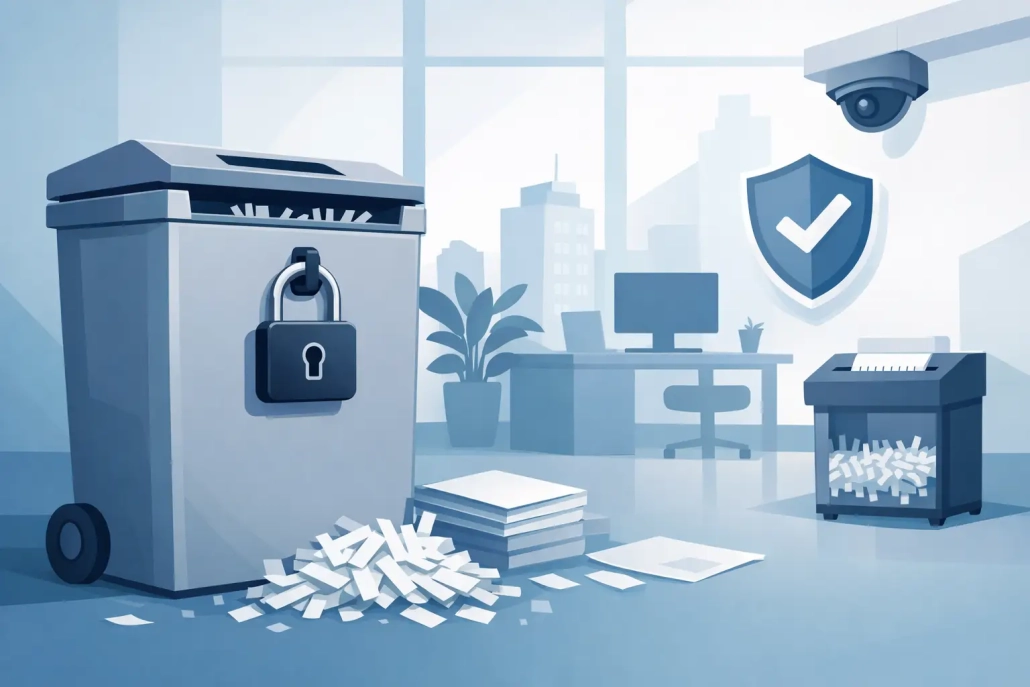
Lockable Shred Bin Review for Secure Offices
A lockable shred bin review should not begin and end with the bin itself. For an office handling employee records, client files, medical information, financial paperwork, or internal reports, the real question is whether confidential paper stays protected from the moment it is discarded until it is destroyed. A lockable bin is a useful control, but only when it forms part of a secure collection and destruction process.
For businesses that generate confidential waste every week, a lockable shred bin can remove a daily security problem from the office. Staff have one clear place to dispose of sensitive paperwork. Documents are contained instead of sitting in desk-side recycling boxes, unsecured cabinets, or bags waiting for someone to deal with them.
Lockable Shred Bin Review: What Matters Most
The best lockable shred bin service is practical enough for staff to use and secure enough for management, compliance teams, and clients to trust. That means looking beyond the lid, the wheels, and the stated capacity.
A locked lid is only the starting point
The primary benefit of a lockable shred bin is restricted access. Once documents are placed through the secure slot, they should not be easy for staff, visitors, cleaners, or contractors to remove. This helps reduce the risk of confidential information being read, copied, or accidentally placed back into general waste.
However, not every lockable bin arrangement delivers the same level of protection. A good service should use bins that remain secured between collections and be handled by authorized collection staff. The provider should also have a clear process for removing the contents and transporting them for destruction.
If a supplier simply collects loose bags from an office, the lockable bin has not solved the full problem. The chain of custody matters just as much as the container. Ask who collects the material, how it is secured in transit, and what happens after it leaves your premises.
Capacity needs to match the way your office works
For many workplaces, a 240-liter lockable bin is a practical choice. It holds a substantial volume of paperwork while remaining compact enough to place near a printer area, records room, mailroom, or shared office space. It is particularly suitable for organizations producing a consistent flow of confidential documents rather than occasional large clean-outs.
Capacity is not just about how much paper fits inside. It affects how often the bin needs service, where it can be located, and whether staff will use it correctly. A bin that fills too quickly can lead to paper being stacked beside it, which defeats the security purpose. A bin that is far larger than needed may take up valuable floor space and result in unnecessary collection costs.
A smaller office may need only occasional pickups. A busy legal practice, medical office, school, or financial services team may need scheduled weekly or monthly collection. The right frequency depends on document volume, available storage space, and the sensitivity of the records involved.
Scheduled service is usually the safer option
A lockable bin is most effective when collection is planned, not left until someone notices it is full. Scheduled pickups give office managers a predictable routine and reduce the temptation to move overflow documents into unsecured storage.
For recurring confidential waste, regular servicing is generally the simplest arrangement. Staff know where to put paperwork, and the office does not need to arrange a separate destruction job every time a cabinet or bin reaches capacity. It also makes budgeting easier because collection requirements are known in advance.
On-call collection can be a better fit for businesses with irregular volumes, seasonal filing cycles, or changing staffing levels. The trade-off is that someone must monitor the bin and request service before it becomes overfilled. For some offices, a combination works well: scheduled bin service for daily paper waste and an on-call pickup for periodic archive disposal.
Security Does Not Stop at Collection
A locked container protects documents while they are inside your office. It does not, by itself, verify that the material was destroyed. This is where the service provider’s procedures matter.
Secure document destruction should involve controlled collection, secure removal, and confirmed destruction. Businesses should receive a Certificate of Destruction after the job or service period, providing a formal record that confidential material was processed for destruction. This is useful for internal records, audit preparation, supplier management, and demonstrating that the business took reasonable steps to protect private information.
The certificate should not be treated as paperwork for paperwork’s sake. It closes the gap between placing documents in a secure bin and knowing they were actually destroyed. For organizations responsible for client, employee, patient, student, or financial information, that proof is a practical part of risk management.
After destruction, paper can be directed into recycling streams rather than landfill. This gives businesses a responsible way to clear confidential documents without choosing between security and environmental considerations. The material must be destroyed first. General recycling bins are not an acceptable substitute for a secure shred bin because documents remain accessible during handling and sorting.
What staff can place in a shred bin
A standard lockable shred bin is designed for confidential paper waste. This can include printed reports, invoices, old correspondence, employee documents, customer records, drafts, outdated forms, and internal files. Staples and paper clips are commonly manageable in professional destruction processes, but each provider may have its own acceptance rules.
Businesses should check before placing large binders, lever-arch files, plastic folders, excessive cardboard, electronic media, or nonpaper items in the bin. These materials may require separate handling. Archive boxes, CDs, uniforms, and other sensitive items can often be collected as part of a dedicated destruction service, but they should not be forced into a paper shred bin.
Clear instructions near the bin make a difference. If staff are unsure what belongs inside, they may use it for general waste or leave sensitive items on top. A simple internal policy can prevent both problems: all confidential paper goes into the locked bin, while other destruction items are set aside for approved collection.
When a Lockable Bin Is Not the Best Fit
Lockable bins are ideal for ongoing office paperwork. They are not always the most efficient choice for a one-time records purge. If a business is clearing years of archived files from storage, removing dozens of boxes, or disposing of pallet-scale records, a dedicated archive box collection is usually faster and more cost-effective.
The same applies when an office is relocating, closing a department, or completing a records retention review. In these cases, the priority is rapid removal of a large volume of material, not maintaining a permanent bin for day-to-day use. A provider that offers both lockable bin service and one-off clean-outs gives the business flexibility without requiring it to manage confidential waste internally.
There is also a practical access issue. Before arranging service, consider where the bin will be placed and how collection staff will reach it. Narrow hallways, stairs, restricted loading areas, building security procedures, and limited parking can all affect pickup planning. A reliable provider should discuss access requirements upfront rather than turning collection day into a problem for your staff.
Questions to Ask Before Choosing a Provider
Price matters, but the cheapest quote is not always the lowest-cost option if it leaves gaps in security, collection reliability, or documentation. Ask whether the bin is lockable, whether scheduled and on-call pickups are available, and whether a Certificate of Destruction is included. Confirm what materials are accepted and whether the provider can also handle archive boxes, CDs, or uniforms when needed.
It is also worth asking how quickly additional collection can be arranged if your office has an unexpected clear-out. Businesses often discover large quantities of confidential paper during moves, audits, staff changes, or storage cleanups. A provider that can respond without creating a long delay helps keep sensitive material from building up on-site.
Metro Paper Destruction provides lockable 240-liter bins, scheduled service, one-off collections, and free Certificates of Destruction for Melbourne businesses that need a straightforward way to manage confidential waste. The right setup should fit your document volume, premises, and collection schedule without adding work for your team.
A secure bin works best when it becomes an ordinary part of office routine: paperwork goes in immediately, the lid stays locked, collections happen on time, and destruction is documented. That is how a simple container becomes a dependable control against a very avoidable information risk.


Leave a Reply
Want to join the discussion?Feel free to contribute!