
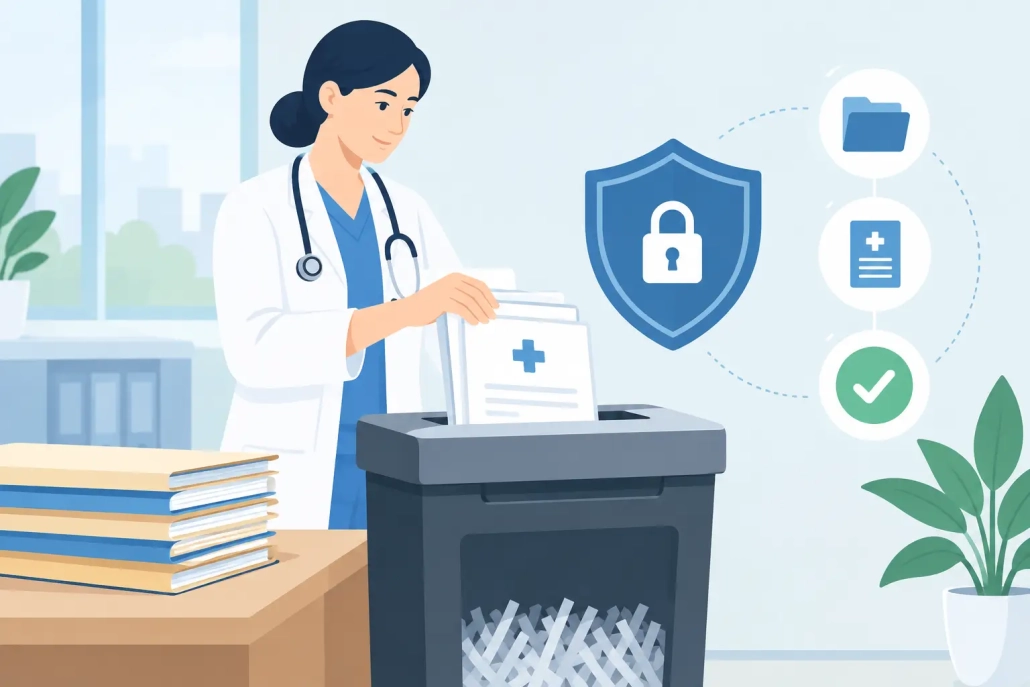
Healthcare Records Disposal Without Gaps
A retired patient file is still a patient file. Names, addresses, dates of birth, treatment notes, referrals, billing details, and test results do not become harmless because they are no longer needed at the front desk. Healthcare records disposal must protect that information right through to final destruction.
For medical practices, dental offices, clinics, allied health providers, and larger healthcare organizations, the risk often sits in storage rooms, old filing cabinets, and archive boxes that have quietly accumulated over years. Throwing records into general waste, leaving boxes in an unsecured pickup area, or relying on an office shredder creates avoidable exposure. A secure disposal process gives your organization control, proof, and a cleaner workspace.
Why healthcare records need a controlled disposal process
Healthcare records contain some of the most sensitive information an organization holds. Even a small batch of files can reveal enough personal and medical detail to cause serious harm if it is lost, accessed, or removed without authorization.
The issue is not limited to paper patient charts. Records may include intake forms, specialist correspondence, prescription information, pathology reports, appointment schedules, insurance documents, consent forms, printed emails, and labels. Old hard drives, CDs, and other media can also contain protected information that needs separate, secure handling.
A controlled process reduces the opportunity for records to be viewed, taken, or misplaced before destruction. It also gives practice managers and compliance staff a clear answer when asked what happened to expired files: they were securely collected, destroyed, and documented.
Retention comes before destruction
Secure destruction does not mean destroying everything as soon as it becomes inconvenient to store. Your organization should first apply its approved records retention schedule and any privacy, health records, contractual, or legal requirements that apply to it.
Some files must be retained for longer periods depending on the patient, record type, service provided, or an active complaint, audit, insurance matter, or legal hold. If there is uncertainty, confirm the retention requirement before placing records in a destruction stream. Once the authorized retention period has ended, holding material indefinitely can create a different problem: more sensitive information to secure, manage, and potentially expose.
The practical goal is simple: retain what you must, then destroy what you no longer need through a documented process.
What secure healthcare records disposal should look like
A reliable service is not just a truck collecting boxes. It is a chain of custody from the moment records leave your control until they are destroyed.
Start with secure collection points. For ongoing paper waste generated by reception, administration, billing, or clinical teams, lockable 240-liter bins provide a simple option. Staff place approved confidential material into the locked bin rather than leaving it in desk drawers, open recycling containers, or hallway boxes. The contents remain contained until scheduled collection.
For smaller volumes or departments without room for a bin, security bags can provide a controlled collection method. For a records room clean-out, archive box destruction and pallet-scale archive removal are more practical. The right format depends on the quantity of records, available space, how quickly material must be cleared, and whether your need is ongoing or one-off.
At collection, records should be removed by a provider that understands confidential material. Boxes should not be opened for sorting on site, and sensitive files should not be transferred through unsecured third parties. Secure transport and documented handling matter just as much as the final shredding step.
After destruction, request a Certificate of Destruction. This document provides evidence that the material was processed for secure destruction and supports your internal records management process. Metro Paper Destruction provides Certificates of Destruction free of charge, so your team has proof of service without an added administrative cost.
Do not overlook non-paper records
Paper files are the obvious concern, but healthcare organizations often store confidential information in less visible places. Old CDs, backup media, printed reports, labeled folders, archived devices, and staff uniforms can all require secure disposal.
CD destruction helps prevent data stored on obsolete media from being recovered or casually discarded. Uniform disposal is also relevant where branded clothing identifies staff, departments, or facilities. It may not contain patient data, but secure destruction helps prevent unauthorized use of your organization’s identity.
For electronic devices such as computers, servers, or USB drives, ask your provider specifically what destruction or data-handling service is available. Paper shredding and media destruction are different services, and the method should match the item being disposed of.
Common gaps that put patient information at risk
Most disposal failures are routine, not dramatic. A busy employee puts old referral forms in a recycling bin. An archive box is placed near a back door for a future clean-out. A staff member takes files home to shred later. None of these actions may feel like a major incident at the time, but each breaks control over confidential information.
Office shredders can be useful for occasional low-volume material, but they are rarely an efficient answer for healthcare archives. They consume staff time, overheat, jam, and leave your team responsible for collecting and securing shredded output. They also do not solve the problem of large quantities of stored files.
Unsecured recycling is a poor substitute for destruction. Recycling supports environmental goals only after confidential paper has been securely destroyed. The correct order matters: secure destruction first, then responsible recycling of the shredded material.
Another common gap is a lack of ownership. If nobody is responsible for reviewing retention dates, arranging pickups, and retaining destruction certificates, confidential records tend to pile up. Assigning a records owner, even in a small practice, makes disposal more consistent and easier to audit.
Choosing the right collection arrangement
The best healthcare records disposal arrangement depends on how your organization generates and stores confidential material.
A busy clinic with regular paper flow may benefit from scheduled pickups and one or more lockable bins. This keeps disposal predictable and prevents confidential waste from building up. A practice that is digitizing old charts, relocating offices, or clearing long-term storage may need an on-call pickup or one-off archive clean-out instead.
For large projects, ask whether the provider can remove archive boxes by the pallet. Manual trips between storage and the parking lot waste staff time and create more handling points. A provider that can manage collection logistics allows your team to focus on patient care and daily operations.
Price matters, but the lowest quote is not useful if the service leaves questions about security, collection timing, or proof of destruction. Compare what is included: secure containers or bags, collection, transport, destruction, a Certificate of Destruction, and recycling. Clear pricing and a free quote make it easier to select a service that fits both your budget and risk requirements.
Build disposal into everyday records management
Secure disposal works best when it is routine rather than a reaction to an overflowing storage room. Keep a retention schedule, identify a responsible staff member, and set a collection schedule that reflects your actual volume. Train employees to recognize confidential waste and make the secure option easier than the unsafe one.
For archive projects, create a simple inventory before collection. You do not need to read every page, but it helps to identify box ranges, departments, dates, and any records that may be subject to a hold. Label approved boxes clearly and keep them in a restricted area until collection.
Store Certificates of Destruction with your records management documentation. If a question arises months later, your organization can show that expired records were managed through an established, secure process.
A secure clean-out can do more than free up a storage room. It gives your healthcare organization a practical way to reduce risk, protect patient trust, and keep confidential information under control until its final destruction.


Leave a Reply
Want to join the discussion?Feel free to contribute!