
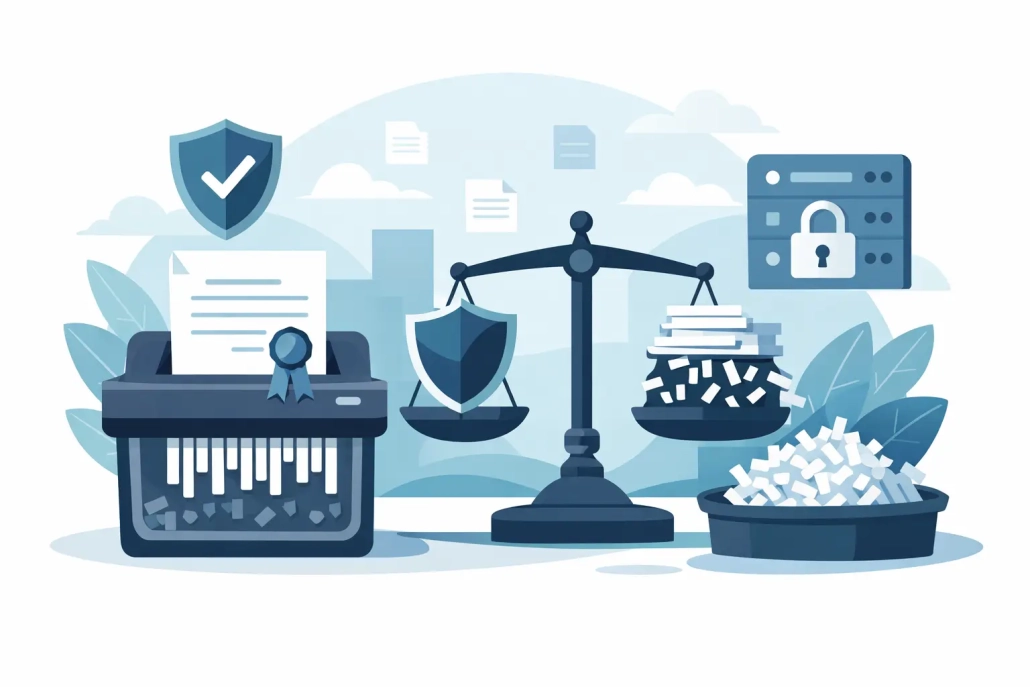
Are Destruction Certificates Legally Required?
A locked bin is only part of a secure disposal process. When sensitive files, customer records, employee information, or old digital media leave your workplace, you need proof of what happened next. Are destruction certificates legally required? Usually, no single law requires every business to obtain a certificate for every destruction job. But the legal duty to protect confidential information can make a certificate one of the most practical records your business keeps.
For businesses handling private, financial, medical, legal, or personnel information, secure destruction is not a task to leave undocumented. A Certificate of Destruction creates a clear record that confidential material was collected and destroyed by a defined provider on a particular date. That documentation can matter during an audit, client review, insurance claim, internal investigation, or privacy incident.
Are Destruction Certificates Legally Required by Law?
The short answer is that it depends on the records, your industry, your location, and the rules that apply to your organization. Many privacy and records-management laws require reasonable safeguards and secure disposal. They do not always state that a document called a “Certificate of Destruction” must be issued.
That distinction matters. A business may have a legal obligation to dispose of personal information securely without being specifically required to hold a certificate. However, if your organization is ever asked to show how it met that obligation, a certificate is far stronger than saying old files were placed in recycling or removed by a general waste contractor.
In the United States, organizations may need to consider obligations under laws and standards such as HIPAA for protected health information, the Fair and Accurate Credit Transactions Act disposal requirements for consumer information, financial privacy rules, state privacy laws, contractual client obligations, and sector-specific retention schedules. Government agencies, schools, law firms, medical practices, and regulated contractors may also have their own procedures.
None of these situations should be reduced to a simple checkbox. Your legal counsel, compliance team, or records manager should confirm the rules that apply to your business. Still, the operational answer is straightforward: if you are required to protect information, retain a record of secure destruction.
What a Certificate of Destruction Proves
A proper certificate is evidence of service, not just a receipt. It should identify the destruction provider, the customer, the date of service, and the type or volume of material destroyed. Depending on the service, it may also include a job or invoice reference, collection location, destruction method, and an authorized statement confirming completion.
This record helps establish a chain of custody. It shows that boxes, bags, bins, media, or uniforms were transferred from your control to a provider operating a secure destruction process. That is particularly useful when confidential records are collected from multiple offices, removed during a relocation, or cleared from long-term storage.
A certificate does not erase every compliance obligation. It will not fix poor retention practices, unprotected records left in public areas, or a provider with weak handling controls. It is one piece of a broader process that should include secure collection, controlled transport, documented destruction, and responsible recycling where appropriate.
When Your Business Should Always Request One
Even where a certificate is not expressly required, there are situations where requesting one should be standard procedure. Medical practices should retain proof when disposing of patient records and other protected health information. Legal and accounting firms should document the destruction of client files after their retention period ends. HR departments should do the same for personnel files, payroll records, identification documents, and background-check materials.
Financial businesses and any company handling customer account information, credit applications, payment records, or identity documents also need a defensible disposal trail. The risk is not limited to active files. Archived boxes, outdated hard-copy reports, returned mail, printed customer lists, and obsolete CDs can all contain enough information to cause a breach.
Certificates are equally valuable when a client contract requires secure disposal. Many organizations now ask vendors to prove how confidential data is handled at the end of a project or retention period. A clear certificate helps your business respond quickly instead of reconstructing events months later.
For internal governance, make certificates part of your records schedule. Store them with service invoices or in a centralized compliance folder, assign responsibility for reviewing them, and retain them for the period your organization determines is appropriate. The key is consistency. A certificate that cannot be found when needed offers little protection.
Secure Disposal Means More Than Shredding Paper
Paper shredding is often the first concern, but confidential disposal extends well beyond office documents. Archive boxes can contain years of client, employee, medical, and financial records. A one-off cleanout may uncover old files that were never entered into a formal retention program. These materials need controlled removal, not an open dumpster or a casual trip to a recycling center.
Digital media needs the same care. CDs, DVDs, backup disks, and other storage media may hold personal data, business records, or proprietary files. Simply throwing them away or snapping a disk in half does not provide a reliable destruction record. A provider should explain what is collected, how it is secured, and how destruction is confirmed.
Uniform disposal can also be a security issue. Branded uniforms, identification clothing, and garments carrying access-related logos may expose your organization to impersonation or reputational risk if they are discarded intact. A certificate can document that these items were removed and destroyed rather than reused or resold.
What to Ask a Destruction Provider
The certificate is only as credible as the process behind it. Before choosing a provider, ask practical questions about collection, handling, and documentation. You should be able to get direct answers about whether materials are placed in lockable bins or security bags, who collects them, how they are transported, and when a certificate is issued.
For recurring services, scheduled pickups can reduce the risk of confidential waste accumulating in offices. Lockable 240-liter bins keep documents contained between collections and give staff a simple disposal point. For archive rooms, relocations, or end-of-year cleanouts, one-off box removal or pallet-scale collection may be the better fit.
Also ask whether the provider can accommodate on-call pickups when your volume changes. A rigid service arrangement can encourage staff to store sensitive documents in unsecured areas while waiting for the next collection. Secure disposal should match the way your workplace actually operates.
A dependable provider should not treat the certificate as an optional extra or a chargeable add-on. It is a basic part of accountable service. Metro Paper Destruction provides Certificates of Destruction free of charge after secure collection and destruction, giving businesses a clear record without adding another administrative cost.
Certificates Support Compliance, but They Also Reduce Risk
The practical value of a certificate becomes clear when something goes wrong. If an employee, customer, regulator, or client asks how certain records were disposed of, your business can provide a dated record instead of relying on memory. That response demonstrates care, process, and accountability.
There is also a commercial benefit. Businesses that can show secure disposal practices are easier for clients, partners, and procurement teams to trust. This is particularly relevant for organizations bidding on work, managing sensitive client data, or supporting larger companies with strict vendor requirements.
Do not confuse a certificate with permission to destroy records early. Retention rules still apply. Before arranging destruction, confirm that records have reached the end of their required retention period and are not subject to a legal hold, audit, investigation, or active dispute. Once that check is complete, secure destruction and documented proof are the sensible next steps.
If your office is holding old files because nobody is certain how to dispose of them, start by separating what must be retained from what can be destroyed. Then arrange secure collection, keep the certificate with your compliance records, and remove a preventable risk from your workplace.


Leave a Reply
Want to join the discussion?Feel free to contribute!