
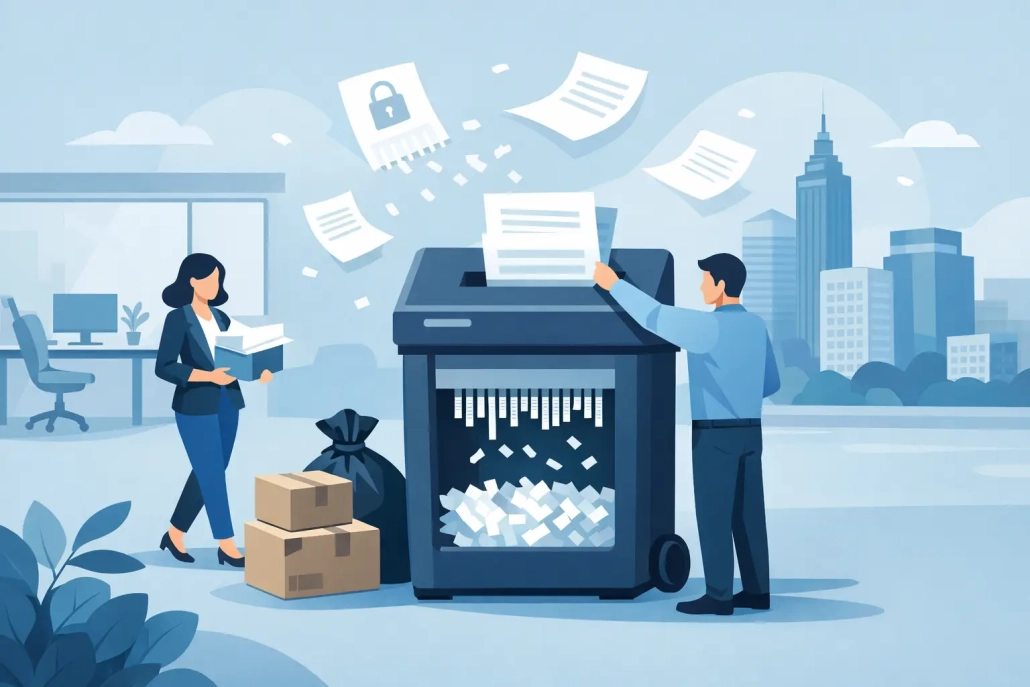
Confidential Paper Disposal for Melbourne Offices
A filing cabinet, printer tray, or back-room archive can hold far more risk than it appears to. Client records, employee files, financial reports, medical information, signed contracts, and internal notes all require confidential paper disposal that keeps information secure from the moment it leaves your office.
For Melbourne businesses, tossing paperwork into general recycling or relying on an office shredder creates unnecessary exposure. A professional destruction service gives you secure collection, documented removal, and proof that confidential material has been destroyed correctly.
What Counts as Confidential Paper?
Confidential waste is not limited to obvious documents such as tax records or customer applications. Any paper that could identify a person, reveal business operations, expose financial details, or give access to internal systems should be treated as secure waste.
This commonly includes employee records, payroll documents, resumes, customer correspondence, invoices, supplier details, legal files, patient paperwork, student records, bank information, printed emails, reports, meeting notes, and outdated marketing lists. Printed copies are often overlooked because they feel temporary. Once they contain names, account numbers, addresses, signatures, passwords, or commercially sensitive information, they need the same level of control as a digital record.
The practical rule is simple: if you would not leave it on a public table, do not place it in an open recycling bin.
Why Office Shredders Are Not Always Enough
A small office shredder can be useful for occasional paperwork, but it is rarely an efficient confidential waste system. Staff must spend time removing staples, feeding pages, emptying bags, cleaning jams, and deciding what should be shredded. In busy offices, that work is frequently delayed, leaving sensitive documents stacked beside the machine or in desk drawers.
There is also the question of security. Shredded material still has to be handled, stored, and moved before final recycling. If it sits in an accessible waste bag, there is no reliable chain of custody. For organizations with high document volumes, archives, or strict privacy obligations, internal shredding can create more handling points rather than fewer.
A secure provider removes that burden. Documents are placed in a lockable collection bin or security bag, collected by trained personnel, transported for destruction, and supported by a Certificate of Destruction. That process gives office managers a clear record instead of an informal promise that someone used the shredder.
How Secure Confidential Paper Disposal Works
A well-run service should be straightforward for your team. The right collection format depends on the amount of paper your business produces and how often it needs to be removed.
For regular office waste, lockable 240-liter bins provide a secure point of disposal near work areas. Employees can place approved documents into the bin throughout the week, without sorting or operating machinery. The bin remains locked until scheduled collection.
For smaller volumes, security bags can suit offices that only produce confidential waste periodically. They are also useful for departments, temporary projects, and sites where a full bin is unnecessary. For larger clear-outs, archive boxes, stored files, and pallet-scale records can be collected directly from your premises.
At collection, the key requirement is controlled handling. Your documents should not be left on a loading dock, transferred into unsecured containers, or mixed with general waste. Secure removal means the material is collected and taken away for destruction under a documented process. Once the job is complete, a Certificate of Destruction provides evidence for your internal records, compliance file, or audit requirements.
Choose the Service Format That Matches Your Records
There is no need to pay for a service schedule that does not suit your business. The most cost-effective arrangement depends on your paper volume, storage space, privacy risk, and internal workflow.
Scheduled pickups are suitable for offices that generate confidential paperwork every day or every week. Medical practices, legal firms, schools, finance teams, and larger administration offices often benefit from a regular collection cycle. It keeps secure bins from becoming overfilled and stops records from accumulating in cupboards.
On-call pickups work well when volumes change from month to month. A business may need extra collections during end-of-financial-year reporting, staff onboarding, a records review, or an office move. One-off clean-outs are a practical option for clearing archived files, old storage rooms, closed departments, or excess paper after digitization.
The right provider should be able to adapt as your needs change. A small office may begin with security bags and move to lockable bins as headcount grows. A large business may maintain a scheduled collection while booking an additional archive removal project when storage costs become a problem.
Do Not Forget Archive Boxes and Mixed Secure Waste
Confidential paper is often stored in archive boxes for years because nobody has time to review every folder. These boxes can contain contracts, personnel files, client records, tax documents, case notes, and historical correspondence. When retention periods have passed, secure archive destruction frees valuable office and off-site storage space while reducing the risk of old records being accessed or misplaced.
Before booking a clean-out, identify the boxes or file series approved for destruction under your records policy. You do not need to sort every page, remove paper clips, or feed documents through an office shredder. A professional collection service can remove sealed archive boxes in bulk.
Some businesses also need secure disposal for items beyond paper. CDs, DVDs, branded uniforms, identification materials, and other media may carry confidential data or create brand-security risks. Keeping these items within the same secure destruction process reduces the chance that a discarded uniform, old disk, or printed report ends up in the wrong hands.
What to Ask a Paper Destruction Provider
Price matters, but the lowest quote is not a good outcome if collection procedures are unclear. Ask how material is secured on site, how it is handled after pickup, and whether the provider issues a Certificate of Destruction without extra charges.
You should also confirm whether they can service your location, provide lockable bins or security bags, collect archive boxes, and accommodate both recurring and one-off work. If your business has multiple sites, changing volumes, or a time-sensitive office clear-out, responsiveness matters as much as the initial price.
Look for a provider that explains the process plainly. You should know what happens before collection, what your staff need to do, how pickup is arranged, and what evidence you receive afterward. Vague assurances are not a substitute for secure containers, controlled removal, and documentation.
Build Disposal Into Everyday Office Practice
Even the best collection service relies on clear habits inside the workplace. Staff should know which documents belong in secure disposal and where the lockable bin or security bag is located. Make confidential disposal easy to use, especially near printers, reception areas, payroll teams, and records rooms where sensitive paperwork is generated.
Avoid leaving documents in open recycling containers, desk-side trash, meeting rooms, or unsecured boxes waiting for a future clean-up. These shortcuts create preventable risk. A simple internal rule – confidential documents go directly into secure collection – is easier to follow than asking employees to judge every page individually.
For larger records projects, nominate one person to approve the material for destruction and retain the Certificate of Destruction with your records register. This helps demonstrate that disposal was deliberate, authorized, and completed through a secure process.
A Practical Next Step for Melbourne Businesses
Confidential waste should not occupy storage space, consume staff time, or sit unprotected while waiting for someone to deal with it. Whether you need a lockable bin for ongoing office use, security bags for occasional disposal, or a complete archive clear-out, the service should fit your operation and give you documented proof of destruction.
Metro Paper Destruction provides secure Melbourne collection options for regular and one-off confidential waste needs, with free Certificates of Destruction and competitive quotes. Put a secure disposal process in place before old files, overflowing drawers, or a rushed office move turn routine paperwork into a privacy problem.


Leave a Reply
Want to join the discussion?Feel free to contribute!