
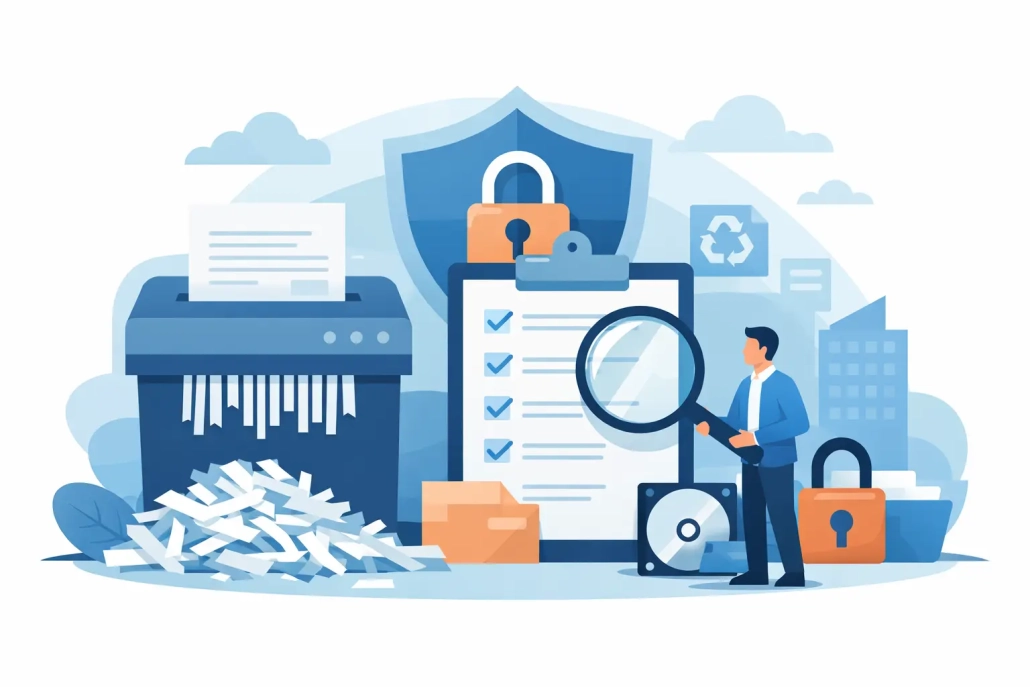
Secure Destruction Compliance Guide for Businesses
A filing cabinet full of old client records can look harmless until one box is misplaced, one employee takes documents home, or a disposal contractor cannot prove what happened after pickup. This secure destruction compliance guide gives businesses a practical way to manage confidential waste without creating a weak point in their privacy, records, or security procedures.
Secure destruction is not simply about feeding paper into an office shredder. It is a controlled process for identifying sensitive materials, securing them before collection, maintaining custody during removal, destroying them to an appropriate standard, and retaining evidence that the work was completed. For offices, clinics, law firms, schools, and government-related organizations, every stage matters.
Start With a Clear Retention and Destruction Policy
Compliance begins before documents reach a secure bin. Your business needs a written retention schedule that states what records you keep, where they are held, who owns them, and when they can be destroyed. The right period depends on the record type, contractual obligations, tax requirements, industry rules, legal holds, and your own operating needs.
Do not destroy records just because storage is tight. If a matter is under investigation, litigation, audit, or a formal legal hold, normal disposal schedules may need to stop. The same applies to records that support an unresolved customer issue, employee claim, or financial transaction. A secure destruction provider can remove approved material safely, but your organization must first authorize its disposal.
Your policy should cover paper records, archived files, employee documents, customer information, invoices, printed reports, CDs, DVDs, USB media, branded uniforms, and other items that could expose personal, commercial, or security-sensitive information. When staff know exactly what belongs in confidential waste, fewer items end up in regular recycling or trash.
Identify What Requires Secure Destruction
Not every sheet of paper needs confidential destruction, but guessing is not a reliable control. As a rule, treat information as confidential when it could identify a person, reveal a business decision, expose account details, or be used to impersonate, defraud, embarrass, or disadvantage someone.
Common examples include personnel files, resumes, payroll records, medical information, legal documents, client files, financial statements, bank details, tax records, student information, supplier contracts, internal reports, passwords, access lists, and printed system data. Old archive boxes often contain a mix of material, which is why entire boxes are commonly destroyed rather than sorted page by page.
Digital media needs the same care. A discarded CD, backup disc, or USB device may hold far more data than a stack of printed pages. Branded uniforms and identification-bearing clothing can also create a security risk if they are reused, copied, or found in general waste. Include these items in your destruction process rather than treating them as ordinary disposal.
Secure Documents Before They Leave Your Site
The most common compliance gap is the period between a document being discarded and its collection. Open desk-side recycling bins, unlocked storage rooms, and cartons left near loading docks create avoidable exposure. Confidential material should be placed immediately into a locked container that staff cannot casually access or remove from.
For ongoing office disposal, lockable 240-liter confidential waste bins provide a practical control. They keep documents contained while allowing staff to dispose of records throughout the day. Security bags can suit smaller offices, departments with limited space, or businesses that need a simple collection point for occasional confidential waste.
Archive clear-outs require a different approach. If you have years of files stored in a records room, warehouse, or off-site area, avoid moving boxes through public corridors or leaving them unattended for collection. Plan the removal route, nominate an authorized contact, and use a provider equipped to collect archive boxes or pallet-scale volumes directly from the site.
Maintain Chain of Custody at Every Handover
Chain of custody means being able to account for confidential material from the moment it enters a secure bin until destruction is complete. It is the practical proof that records did not disappear, sit unsecured, or move through unknown hands.
A sound process records the collection date, location, type or volume of material, and the authorized service provider. Your staff should know who is permitted to release bins, bags, or archive boxes for pickup. If the collection is large or unusual, such as a warehouse archive purge, assign one internal contact to confirm the scope and sign off on removal.
The provider’s collection process matters just as much. Look for secure removal methods, trained personnel, defined handling procedures, and a clear path from your premises to destruction. Mobile customer-site collection can reduce handling and make it easier for your team to oversee the handover. For routine needs, scheduled pickups prevent bins from becoming overfilled or documents from accumulating in unsecured temporary storage.
On-call service is useful when a department has a sudden clean-out, a lease is ending, or a project produces a large amount of confidential waste. The trade-off is that one-off collections require more internal coordination than a regular schedule. Businesses with predictable document volumes are usually better protected by a recurring collection plan.
Require Proof of Destruction
A verbal assurance that documents were shredded is not enough for a compliance file. Ask for a Certificate of Destruction after the service is completed. This document gives your organization a record that confidential materials were collected and destroyed through a documented process.
Keep destruction certificates with your compliance, records management, or procurement documentation. They can help demonstrate that your business had a defined disposal process if a client, auditor, regulator, insurer, or internal reviewer asks how sensitive records are managed at end of life.
A certificate does not replace a retention policy or legal review. It supports the final step after your business has decided that destruction is authorized. Pair it with collection records, service agreements, internal approval notes for major archive destructions, and any relevant destruction log. Together, these records create a more defensible trail than relying on memory or invoices alone.
Match the Service to Your Volume and Risk
There is no single destruction setup that fits every organization. A small professional office may need a security bag collection every few months. A medical practice with steady paper flow may need lockable bins collected on a schedule. A law firm closing old matters or a business relocating may need a one-time archive box removal or pallet-scale clean-out.
Choose a service that removes the burden from staff instead of asking them to manage confidential waste manually. Office shredders are often slow, leave staff responsible for handling every page, and do not solve the problem of storing documents before or after shredding. They may have a place for limited, immediate-use documents, but they are rarely an efficient control for large volumes of sensitive records.
Cost should be considered, but low pricing should not mean unclear custody or missing documentation. Request a quote based on your actual volume, pickup frequency, access requirements, and material type. A provider that can handle paper, archive boxes, digital media, and uniforms may also simplify vendor management for businesses with several disposal needs.
Train Staff and Check the Process
A compliant process fails when employees do not use it. Give new staff clear instructions on what belongs in confidential waste, where secure bins are located, and what must never be placed in general recycling. Remind teams that a document does not stop being sensitive because it is old, duplicated, or no longer useful.
Review the process at least periodically. Check whether bins are locked, whether pickup frequency matches the volume generated, whether departments are storing old records outside the approved process, and whether destruction certificates are being filed. If a business grows, moves offices, adds a new department, or changes systems, its confidential waste process may need to change too.
For Melbourne businesses, Metro Paper Destruction can provide secure collection options for scheduled service, on-call pickups, and large archive removals, with Certificates of Destruction provided at no extra charge. The useful next step is simple: identify the records already approved for disposal, secure them now, and arrange a collection before they become someone else’s problem.


Leave a Reply
Want to join the discussion?Feel free to contribute!