
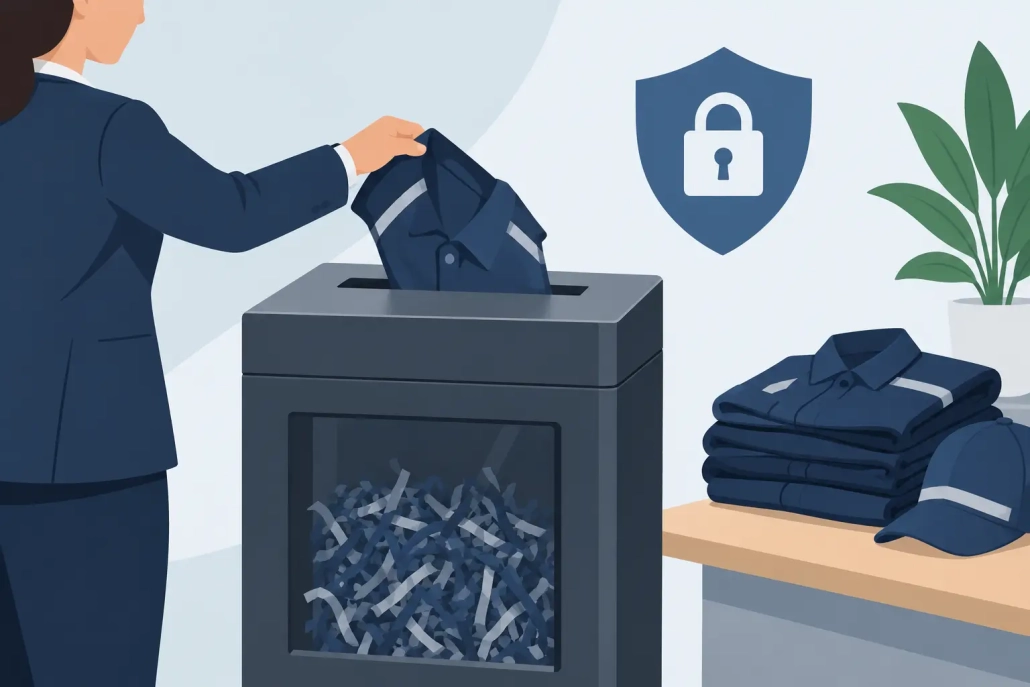
How to Destroy Business Uniforms Securely
A box of old uniforms can look like ordinary clutter until it leaves your building with a company logo, staff name, location, or security designation still visible. Knowing how to destroy business uniforms properly protects your brand, your people, and the sites they represent. It also prevents outdated garments from being reused, sold, or retrieved from general waste.
For many organizations, uniforms identify employees to customers, give access to controlled areas, or signal authority. That makes disposal a security task, not a cleanup task. A secure destruction provider removes the burden from your team while giving you documented proof that the items have been handled correctly.
Why old uniforms create a business risk
A retired polo shirt, jacket, scrubs, hi-vis vest, or work shirt may carry more information than expected. Logos and embroidered names can identify a business. Department labels can reveal a worker’s role. Site names, patches, access tags, barcode labels, and printed phone numbers can provide useful details to someone attempting to impersonate staff.
The risk is highest in industries where uniforms create instant trust. Health care, education, security, transport, utilities, government services, construction, hospitality, and retail businesses should take particular care. A uniform worn by an employee can help someone appear legitimate at a workplace, customer site, school, or residential address.
Discarding uniforms in a dumpster creates a clear gap in control. Donating them without removing identifying details can create another. Even when garments are old, stained, or torn, logos and name badges may remain recognizable. Secure destruction prevents uniforms from being recovered and worn again.
How to destroy business uniforms without creating exposure
The right method depends on the volume of uniforms, the materials involved, and the level of identification on each item. The goal is simple: make the uniform and its branding permanently unusable, maintain control until destruction, and keep a record of the job.
Separate uniforms from general waste
Start by collecting retired, damaged, surplus, and returned uniforms in a designated secure area. Do not leave bags in loading docks, shared waste rooms, or publicly accessible areas. Assign one employee or department to manage the collection so there is a clear internal point of responsibility.
Before collection, check pockets and attachments. Remove keys, ID cards, access fobs, paperwork, USB drives, medical items, or personal belongings. Those items may require a separate secure disposal process. If uniforms include staff ID cards, name badges, or digital access devices, treat those as confidential materials in their own right.
Use a secure destruction service
For most businesses, secure textile destruction is the practical option. A specialist provider collects uniforms from your site, transports them under controlled conditions, and destroys them so they cannot be reassembled, resold, or reused as workwear.
This is more reliable than cutting out a logo with scissors or asking staff to take uniforms home. A partial alteration can leave enough branding behind to identify the organization. It also creates inconsistent handling, with no reliable record of where each garment ends up.
Metro Paper Destruction can arrange secure uniform disposal alongside confidential paper, archive boxes, CDs, and other sensitive business materials. This is particularly useful when an office move, site closure, rebranding project, or staff uniform change creates several disposal needs at once.
Keep the chain of custody clear
A secure process should account for the uniforms from collection through final destruction. Ask how the materials are stored, how pickups are managed, and whether the provider can collect directly from your premises. For ongoing uniform turnover, scheduled service may be the simplest approach. For a one-time cleanout, an on-call pickup can keep the project moving without adding storage pressure.
Good chain-of-custody practices reduce the chance of bags being misplaced, handled by unauthorized people, or mixed into ordinary recycling. They also give compliance staff and management a defensible process if questions arise later.
Obtain a Certificate of Destruction
A Certificate of Destruction is more than a receipt. It provides a formal record that the uniforms were collected and destroyed through a secure process. Keep the certificate with your disposal, security, asset-management, or records-retention documentation.
This matters when your organization has internal privacy policies, contractual security obligations, quality standards, or audit requirements. It also helps demonstrate that the business took reasonable steps to protect its identity after uniforms were retired.
What should be securely destroyed?
Businesses often focus only on shirts with large logos, but secure disposal should cover any item that could identify the organization or help someone pose as an employee. This can include:
- Branded shirts, polos, jackets, pants, dresses, and outerwear
- Hi-vis vests, hard hats, safety gear, and workwear with company markings
- Scrubs, lab coats, aprons, and hospitality garments
- Security, transport, facilities, and maintenance uniforms
- Embroidered name patches, rank insignia, department labels, and logo badges
- Branded bags, caps, lanyards, and other accessories
The decision is not always based on the garment’s condition. A clean, usable uniform may create more risk than a damaged one because it is easier to wear and pass off as legitimate. If it displays a recognizable identity, secure destruction is usually the safer choice.
Can uniforms be recycled after destruction?
In many cases, yes. Textile recycling can be a responsible option after garments have been destroyed or processed so they cannot be reused as uniforms. The specific outcome depends on fabric composition, contamination, attached materials, and the facilities available to process the textiles.
Recycling should never override security. Intact branded uniforms should not be sent into a standard clothing donation or textile recycling stream unless the identifying features have been permanently removed or destroyed. A secure provider can advise on the appropriate handling method for the materials involved.
There is a trade-off to consider. Some garments made from mixed fibers, reflective materials, heavy coatings, or multiple attachments may have fewer recycling options. That does not make secure destruction less necessary. It simply means the final processing route may differ from one batch to another.
When to schedule uniform destruction
Uniform disposal is often left until storage rooms are full. A planned approach is safer and easier to manage. Schedule a collection after a rebrand, staff departure cycle, company merger, location closure, seasonal change, or replacement of safety gear.
Businesses with regular turnover may benefit from adding uniforms to an existing confidential-waste program. Lockable collection equipment and scheduled pickups can keep retired items out of general trash while reducing the need for staff to organize ad hoc disposal each time a garment is returned.
For a large clearout, count or estimate the number of bags, boxes, or garments before requesting a quote. Let the provider know whether items contain hard components such as zippers, patches, badges, or protective equipment. Clear information helps ensure the right collection arrangement and price from the start.
Avoid these common disposal mistakes
Do not place branded uniforms in public donation bins, curbside recycling, or unsecured dumpsters. Do not rely on staff to remove logos at home. Do not sell surplus uniforms online, even if they are outdated. These methods make it difficult to control where the items go and who may obtain them.
Also avoid treating uniform disposal as a minor facilities task when the garments identify employees or sensitive sites. In the same way that confidential documents require secure destruction, branded uniforms deserve a controlled process and proof of completion.
A secure uniform disposal plan gives your organization a straightforward way to protect its identity, clear valuable storage space, and close off an avoidable security risk. When uniforms are no longer needed, arrange collection before they become someone else’s opportunity.


Leave a Reply
Want to join the discussion?Feel free to contribute!