
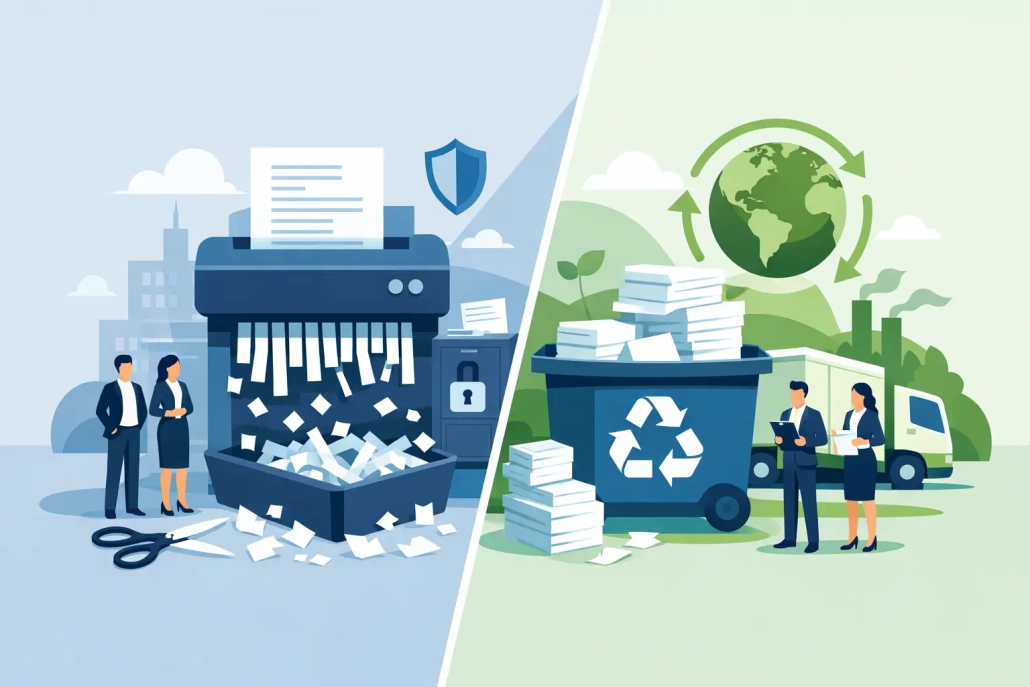
Paper Shredding vs Paper Recycling for Businesses
A recycling bin beside the copier may look like a sensible place for unwanted paperwork. For an invoice, employee roster, client file, or old contract, it can also be the point where control of that information is lost. Paper shredding vs paper recycling is not simply a choice between two disposal methods. For businesses, it is a decision about confidentiality, risk, and what happens to documents after they leave the office.
Recycling has an essential role in reducing waste. But standard paper recycling is not designed to provide secure destruction or a documented chain of custody. When records contain personal, financial, medical, commercial, or internal business information, secure shredding should come first. The shredded paper can then be recycled responsibly.
Paper Shredding vs Paper Recycling: The Key Difference
Paper recycling focuses on recovering material. Paper is collected, sorted, processed into pulp, and made into new paper products. It is the right option for everyday non-confidential material, such as blank misprints, general flyers, clean packaging, and public information sheets.
Paper shredding focuses on making information unreadable before the paper enters the recycling stream. A secure destruction provider collects documents in controlled containers, transports them for destruction, and sends the shredded paper for recycling. This approach protects the information as well as the environment.
The practical difference is control. A general recycling collection may involve open bins, multiple handlers, shared loading areas, and no proof that a particular document was destroyed. Secure shredding creates a controlled process from collection through destruction. For businesses handling sensitive information, that distinction matters.
Why a Recycling Bin Is Not a Security Measure
Most office recycling bins are accessible to anyone nearby. Staff, visitors, contractors, cleaners, and other tenants may be able to see or remove documents before collection. Even if your workplace is secure, paper often sits in a bin for days before it is picked up.
There is also no guarantee that documents placed in a recycling bin will remain separate from general waste or be handled in a way that protects confidential information. A recycling provider’s job is material recovery, not confidential records management.
This can create avoidable exposure for businesses that dispose of documents containing names, addresses, account details, signatures, health information, pricing, payroll records, or internal strategy. A document does not need to be marked “confidential” to create a problem. A single page with enough identifying details can be misused.
When Paper Recycling Is Appropriate
Standard recycling still has a place in a well-run workplace. It is suitable when the paper contains no personal, commercial, or operationally sensitive details and there is no concern about someone reading it before processing.
Examples may include used printer paper with no readable information, publicly available brochures, newspaper, non-sensitive cardboard, and clean paper packaging. Your team should be clear about what belongs in normal recycling and what must go into secure disposal.
The challenge is that office paper is rarely reviewed page by page under pressure. Staff can easily place a meeting agenda with client names, a draft proposal, or a report with internal figures in the wrong bin. That is why many businesses use a simple rule: if there is any doubt, place it in the secure shredding bin.
When Secure Paper Shredding Is the Better Choice
Secure shredding is appropriate for documents that could expose a person, customer, employee, supplier, or business if read by an unauthorized party. This includes records that are no longer needed, as well as duplicate copies, drafts, printouts, and old archives.
Common examples include personnel files, payroll documents, tax records, legal files, medical paperwork, customer correspondence, bank statements, invoices, credit applications, tender documents, purchase records, and internal reports. Businesses should also securely destroy documents with passwords, account numbers, login details, or signatures.
Archive clean-outs need particular care. Boxes stored for years can hold a mixture of historic records, client files, and financial paperwork. Taking them directly to a recycling facility, placing them in a dumpster, or asking staff to use a small office shredder can be slow and risky. A secure archive box destruction service removes the boxes in bulk and handles the destruction process without requiring your team to sort, carry, or feed documents through a machine.
Secure Shredding Can Still Support Recycling Goals
Choosing secure destruction does not mean sending paper to landfill. In fact, secure shredding and paper recycling often work together. Once documents are shredded beyond reconstruction, the paper fibers can be processed for recycling.
This is the practical answer for organizations that need both confidentiality and responsible waste management. The security step happens first, then the material recovery step follows. Your business does not have to choose between protecting private information and reducing paper waste.
The quality of the process matters. Look for a provider that can explain how material is collected, secured, destroyed, and recycled. The best arrangement is one that removes the paperwork burden from your staff while providing clear evidence that confidential material has been handled properly.
What a Secure Disposal Process Should Look Like
A dependable shredding service starts before the truck arrives. Lockable collection bins allow staff to dispose of sensitive paper immediately rather than leaving it on desks, in drawers, or beside the copier. For smaller or occasional volumes, security bags can provide a practical option.
For ongoing records disposal, scheduled pickups keep secure waste from building up. For a relocation, end-of-year clean-out, records review, or archive room clearance, an on-call or one-time collection may be the more cost-effective choice. The right service format depends on how much paper your business produces and how long it can safely remain on site.
At collection, materials should be removed by trained personnel and kept under control through transport and destruction. After destruction, a Certificate of Destruction provides written confirmation that your records were securely handled. This is useful for internal compliance files, audits, management reporting, and peace of mind.
Metro Paper Destruction provides lockable 240-liter bins, security bags, scheduled service, one-time clean-outs, and archive box removal across Melbourne, with a free Certificate of Destruction for each completed service. The goal is straightforward: confidential material leaves your workplace securely, without creating extra work for your team.
Do Not Rely on an Office Shredder for Large Volumes
A desktop shredder can be useful for the occasional page, but it is rarely an efficient system for a business. It takes staff away from their work, jams regularly, requires maintenance, and can leave bags of shredded paper waiting for disposal. Some machines also produce strips that may be less secure than commercial destruction methods.
The bigger issue is consistency. A secure bin gives staff one clear place for documents that must not enter general recycling. That reduces judgment calls, supports better office habits, and makes it easier for managers to maintain a reliable disposal process.
For large archive volumes, using an office shredder is simply impractical. Pallet-scale records removal and bulk box destruction are designed for the jobs that would otherwise consume days of staff time and valuable storage space.
Set a Clear Rule for Your Team
The most effective policy is easy to follow. General, non-sensitive paper goes to recycling. Any document containing personal details, client information, financial data, business records, or internal information goes into secure shredding.
Tell staff where the secure bins are located, who is responsible for arranging pickups, and what to do during an office clean-out. Include remote work and home-office printouts where relevant. A clear process prevents confidential records from ending up in recycling, regular trash, or an unlocked storage area.
If your business has overflowing files, an upcoming move, or paper bins that no one can confidently classify as safe, treat that as a disposal issue worth fixing now. A secure collection and destruction service gives you a practical way to clear the space, protect the information, and send the paper on for recycling after it can no longer be read.


Leave a Reply
Want to join the discussion?Feel free to contribute!