
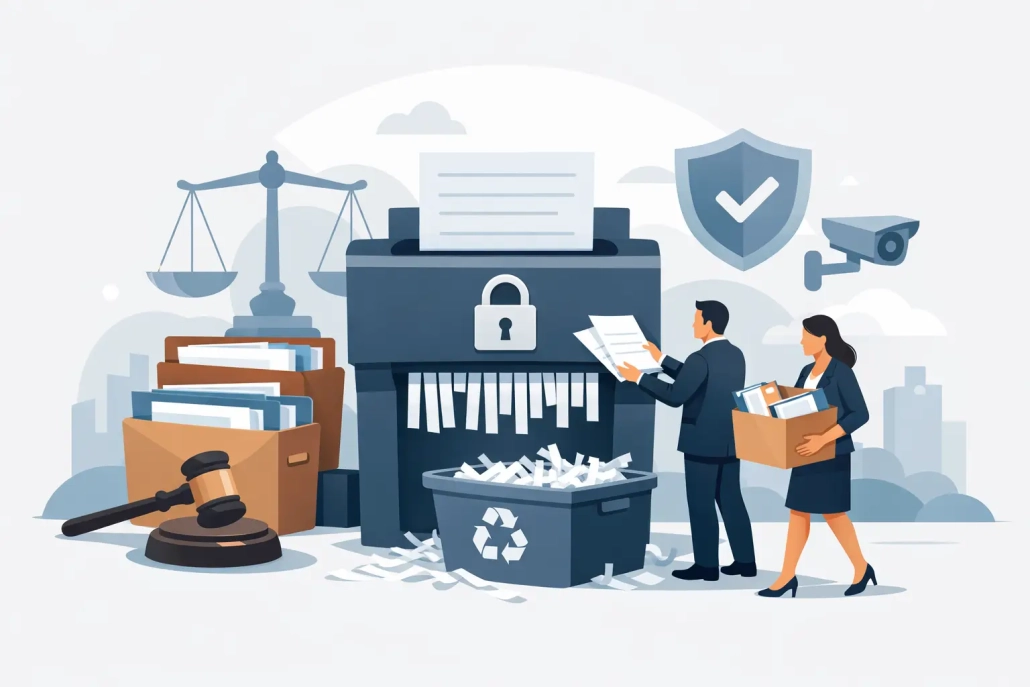
Secure Disposal for Legal Files Done Right
A closed matter is not a harmless matter. Long after a case ends, the paper trail can still expose client identities, financial records, privileged correspondence, medical details, and internal strategy. That is why secure disposal for legal files is not a back-office chore. It is a risk-control process that needs the same attention as file retention, access permissions, and records storage.
Law firms, in-house legal teams, and records managers all face the same pressure: keep files for the right period, then destroy them in a way that protects confidentiality and stands up to scrutiny. If old legal records are tossed into general recycling, left in open bins, or handled by staff without a clear chain of custody, the problem is not just poor housekeeping. It is a preventable security failure.
Why secure disposal for legal files matters
Legal files are different from ordinary office paperwork because they often contain several layers of sensitive information in one place. A single file can include personal identifiers, contracts, court documents, internal notes, billing details, settlement terms, and third-party records. Even draft versions can reveal enough to create a privacy breach.
There is also a reputational issue. Clients expect discretion from legal professionals as a baseline, not an extra. If outdated files are mishandled, the damage goes beyond cleanup costs. It can affect trust, trigger complaints, and create questions about how the firm handles confidential information more broadly.
The practical reality is that most firms do not struggle with knowing they should destroy old files securely. They struggle with volume, timing, and logistics. Archived boxes pile up in storage rooms. Staff run out of space. Someone schedules a cleanup, then delays it because the process feels disruptive. A secure document destruction service solves that bottleneck by removing the burden from internal teams.
What secure legal file destruction should include
Not every shredding setup is suitable for legal records. For legal practices and departments, secure disposal should start before the paper leaves the office. Lockable collection bins and sealed security bags reduce the chance of unauthorized access while files are waiting for pickup. That matters when documents are accumulating across multiple offices, departments, or floors.
Collection should also be controlled and documented. A professional provider picks up materials directly from the customer site, transports them securely, and completes destruction as part of a defined process. If there is no clear chain of custody, the service may be cheap, but it is not doing the real job.
Proof matters too. A Certificate of Destruction gives your business confirmation that the materials were destroyed. For legal and compliance teams, that record is more than a courtesy. It supports internal governance and helps show that expired records were handled properly.
Then there is scale. Some firms need ongoing service for day-to-day confidential waste. Others need a one-time archive purge involving hundreds of boxes. Secure disposal for legal files should work for both. If a provider can only handle small routine shredding but not archive box removal, you may still be left with the hardest part of the problem.
Scheduled service or one-time purge?
This depends on how your legal records move through the business.
If your office generates confidential waste every week, scheduled pickups usually make the most sense. Lockable bins placed onsite create a simple process for staff. Documents go straight into secure containers instead of sitting on desks, in copy rooms, or in temporary cartons. That improves security and keeps your office organized without relying on employees to manage destruction manually.
If your issue is backlog, a one-time cleanout may be the better fit. This is common when firms are relocating, reducing storage, digitizing archives, or clearing out long-retained case files. In that situation, the key question is capacity. Can the provider remove archive boxes in volume, keep the pickup process orderly, and complete the job without dragging it across several weeks?
Some businesses need both. A large purge clears the existing accumulation, then a scheduled service keeps the problem from returning. That is often the most efficient setup for firms that want better control over records going forward.
Common weak points inside legal offices
The biggest risks are rarely dramatic. They are routine habits that create exposure over time.
Open recycling bins are one example. So are boxes of retired files left in corridors, storage rooms, or loading areas while someone decides what to do with them. Another weak point is internal shredding. Small office shredders may seem cost-effective, but they are slow, labor-intensive, noisy, and easy to avoid when staff are busy. Half-destroyed documents, jammed machines, and bags of shredded paper waiting for disposal do not create a reliable security process.
There is also the issue of staff discretion. Without a clear disposal system, people make their own decisions about what goes where. Some records get shredded, some go into trash, and some sit untouched for months. A secure service standardizes that process. Staff use the right bins, pickups happen on time, and confidential material leaves the site under controlled handling.
Choosing a provider for secure disposal for legal files
For legal records, convenience alone is not enough. You want a provider that is clearly built around confidential material, not one that treats document destruction as a side service.
Look at how collection works. Is the service mobile and customer-site based? Are lockable 240-liter bins or security bags available? Can they handle everything from routine office paper to boxed archives? Ask whether they provide scheduled pickups, on-call pickups, and one-off cleanouts. Flexibility matters because legal file volumes are rarely consistent all year.
Ask about documentation. A free Certificate of Destruction should be standard, not an add-on. It is a simple but important sign that the company understands compliance expectations.
Responsiveness matters as well. Legal offices often need fast action when storage areas fill up, when a matter closes in bulk, or when an office move is underway. A provider that is difficult to schedule or vague about timing can create more internal work, not less.
Price is part of the decision, but it should be viewed properly. The cheapest option is not the lowest-risk option if the service lacks secure containers, reliable collection, or proof of destruction. On the other hand, secure service does not need to be overpriced. A strong provider should be able to offer dependable collection and competitive rates at the same time.
What the process should look like in practice
A practical service model is straightforward. Secure bins or bags are placed onsite based on your workflow and volume. Staff deposit expired files and confidential paper directly into those containers. When the bins are full, or when your scheduled date arrives, the materials are collected from your premises and removed for secure destruction. Afterward, you receive a Certificate of Destruction.
For archive projects, the process expands without becoming complicated. Boxed records are identified for destruction, pickup is arranged, and the provider removes the material in bulk. That is far more efficient than asking internal staff to feed years of files through office shredders or make repeated trips to disposal points.
This is where a local service advantage matters. A provider working across Melbourne with mobile collection can respond faster, keep the process simple, and reduce the administrative load on your team. Metro Paper Destruction is built around that model, with secure collection options, flexible pickups, archive box removal, and proof of destruction included.
Security, storage, and office efficiency are connected
Firms often treat records destruction as separate from office operations, but the two are closely linked. Storage rooms packed with closed files reduce usable space. Overflowing cabinets make retrieval harder. Staff waste time deciding what to keep, what to move, and what to destroy. Secure disposal clears space, but more importantly, it supports a cleaner records process.
There is also a people factor. When staff know there is a secure and routine disposal system in place, they are more likely to follow it. That lowers the chance of informal workarounds and keeps confidential waste from drifting into general office traffic.
The result is not just less paper. It is a more controlled environment for information handling.
Legal files deserve a clear end-of-life process, not a last-minute cleanup. When destruction is secure, documented, and easy to schedule, your team spends less time managing risk and more time staying focused on client work.


Leave a Reply
Want to join the discussion?Feel free to contribute!