
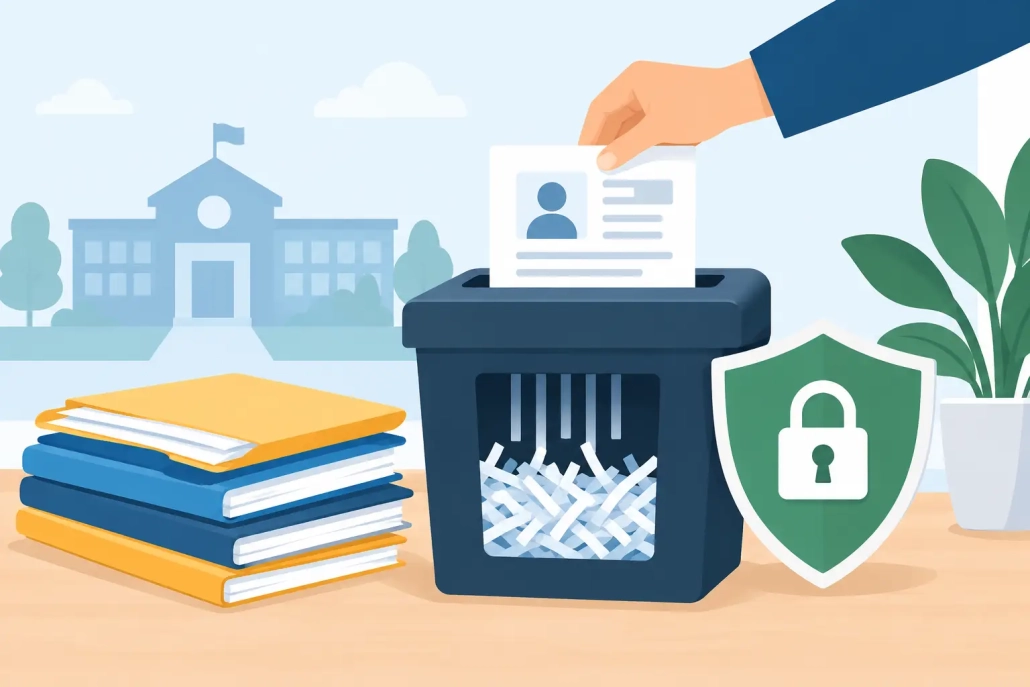
School Records Disposal That Protects Student Data
A box of old student files is not just taking up room in a storage closet. It may contain names, addresses, dates of birth, health information, disciplinary records, family details, and financial documents. Leaving those records unsecured – or disposing of them in regular trash or recycling – creates an avoidable privacy risk.
School records disposal needs a clear process: retain records for the required period, separate material approved for destruction, keep it secure until collection, and obtain proof that destruction occurred. This protects students, families, staff, and the school itself while freeing up valuable office and archive space.
Why School Records Need Secure Disposal
Schools handle a high volume of confidential information. Even records that appear routine can expose personal details when combined with other documents. Enrollment forms, report cards, special education paperwork, attendance records, counseling notes, medical files, payroll records, and staff personnel files all require careful handling at the end of their retention period.
Throwing papers into a dumpster, office recycling bin, or unsecured paper collection point is not a secure disposal method. Bags can be opened, documents can be removed, and confidential information can be seen by unauthorized people before recycling takes place. A torn document is not necessarily unreadable, either.
Secure destruction reduces this exposure by keeping records under control from the point they leave your office through to final destruction. For a school administrator, records manager, or office manager, that means less uncertainty around who handled the material and where it went.
Start With a Retention and Disposal Review
The first step is not shredding everything that looks old. Schools should follow their applicable state, local, district, and records-management requirements before authorizing destruction. Retention periods vary by document type, and some records may be subject to a legal hold, audit, investigation, grant requirement, or ongoing student matter.
Create a straightforward approval process for records that have reached the end of their retention period. This may involve the principal, district records officer, business office, legal counsel, or compliance staff, depending on the school’s structure. The goal is to prevent both common mistakes: keeping sensitive records indefinitely without a reason, or destroying documents that must still be retained.
A practical review should identify the record category, the date range, the retention requirement, and the person approving disposal. Keep a disposal log that records what was authorized for destruction. You do not need to list every page, but the log should clearly identify the boxes, departments, date ranges, and record types involved.
Records Commonly Included in Secure Destruction
Once retention requirements are met, secure destruction may be appropriate for a wide range of paper records. These often include outdated enrollment packets, duplicate student files, superseded reports, obsolete forms, archived administrative paperwork, former employee files, payroll documents, invoices containing personal details, and expired health or counseling paperwork.
The same principle applies to non-paper media. Old CDs, DVDs, USB drives, and other media may hold student, staff, or operational information. They should not be placed in general e-waste bins without confirming that the data has been securely destroyed.
Keep Records Secure Before They Leave the School
The period before destruction matters as much as the destruction itself. A pile of approved files left beside a copier or in an unlocked hallway is still exposed. Schools need a controlled holding process while they prepare archive boxes or schedule a collection.
For ongoing confidential waste, lockable collection bins placed in administration areas, finance offices, health offices, and records rooms provide a simple control. Staff can deposit confidential paper without needing to decide whether it belongs in regular recycling. The material stays contained until scheduled pickup.
For larger clean-outs, use archive boxes that can be sealed, labeled, and stored in a restricted area until collection. Labels should identify the department or disposal batch, not disclose sensitive student information on the outside of the box. Avoid writing student names, medical details, or case numbers where they can be seen by others.
Access should be limited to authorized staff. It is also sensible to appoint one person to coordinate the project, confirm which boxes are ready, and sign off on collection. This creates accountability without adding unnecessary administration.
Choose a Destruction Service With a Clear Chain of Custody
A secure provider should do more than collect boxes. The service should have a defined chain of custody, secure transport, and documented destruction. Ask direct questions before booking: How are records collected? Are bins lockable? Are archive boxes handled securely? What happens after pickup? Will the school receive a Certificate of Destruction?
For many schools, the most practical arrangement depends on the volume of records and how often confidential material accumulates. A scheduled service suits offices that regularly produce confidential paperwork. An on-call pickup may work better for periodic file purges. A one-time archive clean-out is often the right choice when a records room, storage cage, or off-site archive has become overcrowded.
There is a trade-off between holding records for a large annual clean-out and arranging more frequent collection. Larger one-time removals can be efficient for established archives, while regular service reduces the amount of confidential paper stored on site. The right approach depends on available storage, staff workflow, and the school’s internal records schedule.
Certificates Matter After School Records Disposal
A Certificate of Destruction gives the school formal evidence that the material was securely destroyed. This document should be retained with the school’s disposal log and any internal approval records. If questions arise later during an audit, privacy review, or records inquiry, the school has a clear record of what happened to the files.
The certificate is not just paperwork. It supports a defensible disposal process by showing that confidential material was not simply discarded. For schools managing sensitive student and employee information, that proof is a practical safeguard.
It is also worth keeping collection dates and service records organized by department. Finance, student services, human resources, nursing, and administration may each have different record categories and retention responsibilities. A simple filing system makes it easier to show that disposal was handled consistently.
Avoid These Common Disposal Mistakes
The biggest risk is treating confidential school records as ordinary waste. But other gaps can create problems too. Staff may place documents in open recycling containers, leave purge boxes in accessible areas, destroy records before approval, or assume that a digital copy means paper records can automatically be discarded.
Another issue is incomplete clean-outs. A school may pay to remove visible archive boxes while leaving loose files, old binders, CDs, and confidential materials in desk drawers or storage cabinets. Before collection, ask departments to check all likely storage points. This helps prevent sensitive information from being forgotten and reduces the need for repeated clean-outs.
Staff training should be short and practical. Employees need to know what belongs in secure collection, where the locked bins are located, who approves archive destruction, and what to do if they find old confidential files. Clear instructions are more effective than a complicated policy nobody can follow during a busy school day.
Make Disposal Part of a Routine Records Process
The most effective school records disposal programs are routine rather than reactive. Set a regular review date, identify records due for disposal, obtain approval, and schedule collection before storage areas become unmanageable. This approach spreads the work across the year and prevents rushed decisions when a cabinet or archive room is full.
Secure document destruction also supports a cleaner, more usable workplace. Instead of paying to store expired records or asking staff to spend hours feeding paper through office shredders, schools can remove approved material in a controlled, documented manner. Paper can then be handled for responsible recycling after destruction.
When old student and staff records have reached the end of their required life, do not let them become an unsecured storage problem. Put a documented destruction process in place, keep files protected until collection, and make proof of secure disposal part of the school’s records file.


Leave a Reply
Want to join the discussion?Feel free to contribute!